An upcoming all-island (Northern Ireland and the Republic of Ireland) research and stakeholder event aims to move beyond fear-based narratives, and toward evidence-informed, individualised physical activity support and guidance for women during preconception, pregnancy and postpartum.
Introduction
Across the island of Ireland, conversations around physical activity during preconception, pregnancy and postpartum are changing. Women increasingly want clear, consistent and empowering guidance that supports movement safely and confidently throughout these life stages (1,2). Yet too often, support remains inconsistent, overly cautious, or influenced by myths and misconceptions rather than evidence (1,2).
The upcoming Health Research Board funded event (Figure 1) hosted at Ulster University brings together researchers, healthcare professionals, exercise professionals, policymakers, community organisations, and women with lived experience to shape a more connected and evidence-informed future.
Figure 1 Forward Momentum Event Details
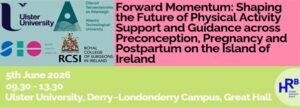
This event represents the first initiative of its kind across the island of Ireland and recognises important international advancements, including developments across the UK, while acknowledging the urgent need for coordinated action within our own communities and healthcare systems.
Why this conversation matters
Physical activity is not simply about exercise and sport participation, it is a key component of maternal health, wellbeing and impacts intergenerational health outcomes (3,4). Growing evidence continues to demonstrate benefits for physical and mental health during preconception, pregnancy and postpartum, including improved cardiovascular health, reduced risk of complications, enhanced wellbeing, and support for recovery after birth (5-10).
However, many women still report uncertainty about what is safe, when to modify activity, or where to access trusted guidance. In many cases, fear-based messaging continues to dominate despite the absence of clinical contraindications (1,2,11).
Our research (1,2,11-14), which includes women from across the island of Ireland and the UK, consistently highlights a shared message:
“We need more guidance, more encouragement and empowerment for what our bodies are capable of.”
Women are seeking:
- Individualised support
- Consistent and evidence-informed guidance
- Greater confidence from professionals supporting them
- Practical advice that fits their pregnancy(s) and lived experiences
Importantly, this support network extends beyond healthcare systems alone. Partners, family members, exercise professionals, coaches and wider communities all influence women’s experiences and confidence around movement.
The evidence to action gap
This event builds on our growing programme of research (1,2,11-14) which has identified clear opportunities for change across the island such as:
- Improving confidence and knowledge among professionals
- Reducing inconsistent advice
- Challenging myths and misconceptions
- Supporting return to movement, exercise and sport postpartum
- Embedding women-centred approaches into policy and practice
This work also recognises nuance and inclusivity. Experiences of preconception, pregnancy and parenthood are diverse, including surrogates and individuals who may not identify as women. While this specific event focuses on women’s experiences and needs, the broader research goal remains inclusive and person-centred support for all individuals navigating these life stages.
Momentum Together
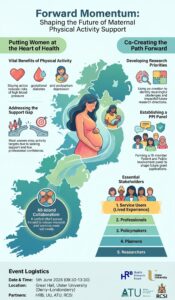
This event is ultimately about collaboration with women and those that support them through preconception, pregnancy and postpartum (Figure 2). Crucially our work shows that no single profession, organisation or sector can address these challenges alone.
By bringing together key stakeholders across healthcare, physical activity, community, research and policy settings, this event aims to create meaningful dialogue and practical solutions that support women to move with confidence before, during and after pregnancy.
The future of maternal health across the island of Ireland must include movement individualised appropriately across these critical life stages. The movement should be informed by evidence and shaped by the voices of women themselves.
Figure 2: Forward Momentum Event Overview
Take-home messages
- Women want clearer, more empowering and individualised physical activity support during preconception, pregnancy and postpartum.
- Fear-based narratives and inconsistent guidance remain significant barriers despite growing evidence supporting movement in the absence of contraindications.
- Collaborative, all-island approaches are needed to improve maternal and intergenerational health outcomes through evidence-informed physical activity support.
Authors and Affiliations
Dr Maria Faulkner, School of Health, Sport Science and Nutrition, Department of Sport Science and Performance, Atlantic Technological University, Donegal, Ireland
Dr Lizzy Deery, Centre for Exercise Medicine, Physical Activity and Health, Sports and Exercise Sciences Research Institute, Ulster University, Belfast, UK
References
1.Deery E, Bonner O, Faulkner M. From insight to action: a qualitative study of the postpartum return to recreational exercise and sport in Ireland and the UK. BMJ Open Sport & Exercise Medicine 2025;11(1):e002369.
2.Faulkner M, Currie S, Fitzpatrick B, Deery E. “We need more guidance, more encouragement and empowerment for what our bodies are capable of”, pregnant and postpartum women’s knowledge and experiences of receiving physical activity guidance and support on the island of Ireland: an online survey study. BMC Pregnancy and Childbirth 2025;25:1.
3.MohdNor FH, Jamani NA, AbdAziz KH. Impact of structured physical exercise during pregnancy on maternal health and fetal outcomes: a systematic review. Med J Malaysia 2025;80(4):508–520.
4.Redondo-Delgado P, Santos-Lozano A, Maroto-Izquierdo S. Impact of exercise training during pregnancy on maternal biomarkers: a systematic review. Obstet Gynecol 2026;234(1):61–77.
5.Deprato A, Ruchat S, Ali MU, Cai C, Forte M, Gierc M, et al. Impact of postpartum physical activity on maternal depression and anxiety: a systematic review and meta-analysis. Br J Sports Med 2025;59(8):550–561.
6.Davenport MH, Meah VL, Ruchat S, Davies GA, Skow RJ, Barrowman N, et al. Impact of prenatal exercise on neonatal and childhood outcomes: a systematic review and meta-analysis. Br J Sports Med 2018;52(21):1386–1396.
7.Davenport MH, Ruchat S, Poitras VJ, Garcia AJ, Gray CE, Barrowman N, et al. Prenatal exercise for the prevention of gestational diabetes mellitus and hypertensive disorders of pregnancy: a systematic review and meta-analysis. Br J Sports Med 2018;52(21):1367–1375.
8.Davenport MH. Shining a light on the postpartum period–supporting the emotional and physical health of mothers and infants through movement. Br J Sports Med 2025;59(8):513–514.
9.Beamish NF, Davenport MH, Ali MU, Gervais MJ, Sjwed TN, Bains G, et al. Impact of postpartum exercise on pelvic floor disorders and diastasis recti abdominis: a systematic review and meta-analysis. Br J Sports Med 2025;59(8):562–575.
10.Ruchat S, Beamish N, Pellerin S, Usman M, Dufour S, Meyer S, et al. Impact of exercise on musculoskeletal pain and disability in the postpartum period: a systematic review and meta-analysis. Br J Sports Med 2025;59(8):594–604.
11.Deery E, Currie S, Fitzpatrick B, Faulkner M. Pregnant and Postpartum Women’s Physical activity beliefs and behaviours during pregnancy on the island of Ireland: an online survey study. 2025.
12.Faulkner M, Donnelly GM, Deery E. Forward momentum: advancing the delivery of pregnancy and postpartum physical activity guidance and support across the island of Ireland. BMJ Open Sport & Exercise Medicine 2025;11(3).
13.O’Keeffe A, Deery E, Currie S, McMonagle G, Faulkner M. 172; The Effects of Antenatal Behaviour-Change Lifestyle Interventions on Improving Maternal and Foetal Health Outcomes: A Systematic Review and Meta-Analysis Protocol. Eur J Public Health 2024;34.
14.Deery E, Faulkner M, Currie S, Fitzpatrick B. 98 Health care practitioners’ knowledge, use and confidence of PA guidelines and tools during pregnancy on the island of Ireland: a protocol and preliminary data. Eur J Public Health 2024;34(Supplement_2):ckae114.170.