This is a reflection and historical editorial opinion piece by John Orchard.
Keywords: Cricket, Anniversary, Public Health
The England and Australia men’s cricket teams play Test matches to contest the Ashes series roughly every second year (each team hosting a five Test series every 4th year). Australia has just hosted a series in late 2025-early 2026 and it will be England’s turn in their summer of 2027. Between these two series is a one-off Test match to be played at the Melbourne Cricket Ground in March 2027 to celebrate the 150 year anniversary of the first Test match between the two countries. For cricket fans of a certain age, this match will be particularly anticipated as the 100 year anniversary match at the same ground in 1977 was one of the most memorable Test matches of all time. Australia won the 1977 Centenary Test narrowly after a titanic struggle over 6 days (which included a rest day, as was the custom of that era). The match was attended by Queen Elizabeth II, and could perhaps be seen in hindsight as the last match of the “amateur” era of cricket. Behind the scenes in 1977, many players were signing contracts to play for a rebel cricket competition for professional amounts of pay (for the first time). This rebel competition (World Series Cricket) split the game for the following two years but successfully ushered in the era of professionalism in the sport. It was an era when the first colour TVs were being found in homes, soon to be followed by the first personal computers, but well before the widespread introduction of the internet. The cricketers of 1977 were privileged to be amongst the few in society who could regularly avail international travel, as the jet era had also recently begun. A set of stamps were produced to commemorate the Centenary Test in 1977 in an era when postal communication predominated (Figure 1).
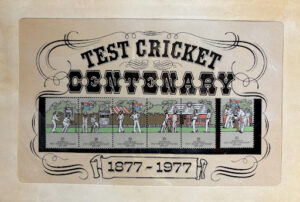
Figure 1 – 1977 Australian stamps celebrating the Centenary Test
Of the 22 players who took the field, as of December 2025, 8 have died with 14 surviving, mainly now aged in their 70s and early 80s (Table 1). Whilst this may seem to be a significant rate of attrition, there is now sufficient data to show that, in fact, Australian and English cricketers, like other athletes, have lower death rates than the general population (1, 2, 3). The most likely explanation for this is the now known benefits of regular exercise. The seminal study which started to show this association was an English one predating the Centenary Test by over twenty years (4). Australian as a country has a generous climate, high rates of sporting participation and an excellent health system which no doubt contribute to it having one of the greatest life expectancies in the world (5).
| Australian players | 2025 status | English players | 2025 status |
| GS Chappell | Aged 77 | AW Greig | Died aged 66, cancer |
| RW Marsh | Died aged 74, heart disease | APE Knott | Aged 79 |
| IC Davis | Aged 72 | JM Brearley | Aged 83 |
| RB McCosker | Aged 78 | RA Woolmer | Died aged 58, sudden/uncertain |
| GJ Cosier | Aged 72 | DW Randall | Aged 74 |
| DW Hookes | Died aged 48, head injury (assault) | DL Amiss | Aged 82 |
| KD Walters | Aged 79 | KWR Fletcher | Aged 81 |
| DK Lillee | Aged 76 | JK Lever | Aged 76 |
| GJ Gilmour | Died aged 62, liver disease | DL Underwood | Died, aged 78, complications of dementia |
| KJ O’Keeffe | Aged 75 | CM Old | Aged 76 |
| MHN Walker | Died aged 68, cancer | RGD Willis | Died, aged 70, cancer |
Table 1 – 2025 life status of the 1977 Centenary Test participants
Fellow celebrity entertainers of the modern era – rock musicians – in contrast to athletes have higher death rates than the general population (2, 6). The world’s most successful rock band of 1977 was the Bee Gees, an English-Australian band, with, ironically, one of their biggest 1977 hits being “Stayin’ Alive”. Of the four Gibb brothers, only Barry survives into his late 70s with Maurice, Robin and Andy having made outstanding contributions to popular culture with their music but having died prematurely like many other rock musicians.
Medicine and public health have achieved a miraculous improvement in life expectancy over the last 50 years (5). Sport and exercise medicine is now a fully-fledged specialty in both Australia and the UK, helping both elite athletes (such as the professional cricketers of both nations) but also the general public, assisting with injury management and exercise promotion (7, 8). Despite the evolution of popular culture, Test cricket between England and Australia endures and is perhaps even more loved because of the connection to the past. Life was different 50 years ago and even more so 150 years ago, although not necessarily better. Those who witnessed (or even played in) the Centenary Test of 1977 and who live to see the 2027 150 year Test almost certainly will have the privilege of doing so due to the contributions of modern medicine and public health. Parts of the 20th Century world (such as postage stamps and black and white television) have faded into obscurity. A sporting format like Test cricket (which requires 5 day to only perhaps achieve a decisive result) seems as though it belongs back in the 20th Century but has never been more popular.
It is also worth reflecting on the massive contribution that public health has made to life expectancy over the past 50 years at a time when public health is under threat from populism and anti-intellectualism. Sport and exercise medicine potentially has a role to play at repairing the bridge between right-wing populism and public health, as sport itself has never been more popular.
Author: John Orchard
References
- Luies N, Orchard JJ, Driscoll T, et al. Sheffield Shield Cricketers Live Longer than the Age‐Matched General Australian Male Population. Indian journal of orthopaedics 2023;57:1613-18.
- Orchard JW, Driscoll T, Davis A, et al. Comparison of cancer and all-cause death rates of Australian rock and pop musicians, footballers, cricketers and the general population. JSAMS Plus 2024;4:100070. doi: https://doi.org/10.1016/j.jsampl.2024.100070
- Mayhew L. The longevity of sporting legends https://ilcuk.org.uk/the-longevity-of-sporting-legends/: International Longevity Centre UK; 2021 [
- Morris JN, Heady JA, Raffle PAB, et al. CORONARY HEART-DISEASE AND PHYSICAL ACTIVITY OF WORK. The Lancet 1953;262(6795):1053-57. doi: https://doi.org/10.1016/S0140-6736(53)90665-5
- Australian Institute of Health and Welfare. Deaths in Australia. https://www.aihw.gov.au/reports/life-expectancy-deaths/deaths-in-australia/contents/life-expectancy, 2025.
- Wolkewitz M, Allignol A, Graves N, Barnett AG. Is 27 really a dangerous age for famous musicians? Retrospective cohort study. BMJ 2011;343:d7799. doi: 10.1136/bmj.d7799
- Fahmy J, Kamel F, Fahmy M, et al. A Comparison of Sports and Exercise Medicine Training for Physicians Across Five English-Speaking Countries. Cureus 2025;17(9):e93201. doi: 10.7759/cureus.93201 [published Online First: 20250925]
- Cricket Sports Medicine. https://doi.org/10.1007/978-981-96-6321-7: Springer Nature 2025.