This blog provides a summary of a recent study published in BJSM.
Why is this study important?
Non-communicable diseases—like cardiovascular disease, type 2 diabetes and dementia—cause most deaths and disability worldwide (1,2). Clinicians need quick, low-cost tools to identify patients at higher risk before disease develops.
Muscular strength has long been linked with health (3). But can simple field-based muscular strength tests really predict who will develop long-term health conditions? And if so, which tests are most useful in everyday clinical practice?
In our systematic review and meta-analysis of 155 cohort studies (94 included in meta-analyses), we examined whether simple field-based muscular strength tests—particularly handgrip strength and the 5-repetition chair-stand test—predict future health outcomes in adults (4).
Turns out, they do.
How did the study go about this?
We searched major databases up to November 2024 and included longitudinal cohort studies in adults (≥18 years) that examined simple, validated and reliable muscular strength tests (5,6) and future health conditions.
Two tests dominated the scientific literature:
- Handgrip strength (HGS) – measured by squeezing a handheld device that indicates the strength of the squeeze in kilograms.
- 5-repetition chair-stand test (5-CST) – measured by the time required to stand up and sit down five times.
We focused on studies that looked at incident (newly diagnosed) long-term conditions, including cardiovascular diseases, cancer, type 2 diabetes, respiratory diseases, musculoskeletal impairment, disability, anxiety, depression, cognitive decline, dementia, and Parkinson’s disease.
We looked at studies that compared adults with the highest versus lowest strength levels and examined the risk reduction per 5-kg increase in grip strength and per 1-second decrease in 5-CST.
What did we find?
The findings were consistent.
Handgrip strength
Adults with the highest (vs lowest) grip strength had lower risk of:
- Parkinson’s disease ↓47%
- Disability ↓43%
- Cognitive decline ↓43%
- Dementia ↓38%
- Musculoskeletal impairment ↓35%
- Depression ↓30%
- Cardiovascular diseases ↓27%
- Type 2 diabetes ↓21%
- Anxiety ↓21%
Even relatively small differences in strength mattered for health. An increase of 5 kg in grip strength was associated with lower risk of:
- Disability ↓21%
- Parkinson’s disease ↓14%
- Dementia ↓13%
- Musculoskeletal impairment ↓8%
- Cardiovascular diseases ↓7%
- Cognitive decline ↓7%
- Depression ↓6%
- Type 2 diabetes ↓5%
These effects may look modest, but at a population level, they are clinically meaningful.
Chair-stand test
Better performance was also protective. Compared with the worst performers, the best performers had lower risk of:
- Musculoskeletal impairment ↓48%
- Disability ↓42%
- Depression ↓37%
- Dementia ↓32%
- Type 2 diabetes ↓20%
Every 1-second improvement was associated with lower risk of musculoskeletal impairment (↓6%).
While the strength of evidence varied across outcomes, the overall direction of findings was consistent across large and diverse populations.
What are the key take-home points?
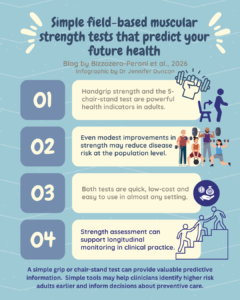
- Handgrip strength and the 5-chair-stand test are powerful health indicators in adults.
- Together, they consistently predict a wide range of chronic physical and mental health conditions
- Even modest improvements in strength may reduce disease risk at the population level.
- Both tests are quick, low-cost and easy to use in almost any setting.
- Strength assessment can support longitudinal monitoring in clinical practice.
- Tracking muscular strength over time may help identify earlier risk and guide preventive or rehabilitation strategies.
In busy clinical practice, a simple grip or chair-stand test can provide valuable predictive information. These simple tools may help clinicians identify higher risk adults earlier and inform decisions about follow-up and preventive care.
Sometimes, the simplest measures are the most powerful.
Authors and affiliations
Bruno Bizzozero-Peroni 1,2,3 , Nuria Marín-Jiménez 4,5,6 , Pablo Molina-Garcia 7,8 , Francisco B Ortega 8,9,10 , Jean-Philippe Chaput 11,12 , Kai Zhang 11,13 , Justin J Lang 11,14,15 , Ryan McGrath 15,16,17,18 , Grant R Tomkinson 15 , Vicente Martínez-Vizcaíno 3,19 , Magdalena Cuenca-García 4,5 , Jose Castro-Piñero 4,5
- Department of Neurobiology, Care Sciences and Society, Aging Research Center, Karolinska Institutet and Stockholm University, Stockholm, Sweden
- Department of Physical Education and Health, Higher Institute of Physical Education, Universidad de la República, Rivera, Uruguay
- Health and Social Research Center, Universidad de Castilla La-Mancha, Cuenca, Spain
- Department of Physical Education, GALENO Research Group, University of Cadiz Faculty of Education Sciences, Cadiz, Spai
- Instituto de Investigación e Innovación Biomédica de Cádiz (INiBICA), Cádiz, Spain
- Department of Education, Faculty of Educational Sciences, Health Research Centre, University of Almería, Almería, Spain
- Instituto de Investigación Biosanitaria ibs, Granada, Spain.
- Department of Physical Education and Sports, Faculty of Sport Sciences, Sport and Health University Research Institute (iMUDS), University of Granada, Granada, Spain.
- Faculty of Sport and Health Sciences, University of Jyväskylä, Jyväskylä, Finland.
- CIBER de Fisiopatología de la Obesidad y Nutrición (CIBEROBN), Instituto de Salud Carlos III, Granada, Spain.
- Healthy Active Living and Obesity Research Group, Children's Hospital of Eastern Ontario Research Institute, Ottawa, Ontario, Canada.
- Department of Pediatrics, Faculty of Medicine, University of Ottawa, Ottawa, Ontario, Canada.
- School of Human Kinetics, Faculty of Health Sciences, University of Ottawa, Ottawa, Ontario, Canada.
- Centre for Surveillance and Applied Research, Public Health Agency of Canada, Ottawa, Ontario,Canada.
- Alliance for Research in Exercise, Nutrition and Activity (ARENA), School of Allied Health and Human Performance, Adelaide University, Adelaide, SA, Australia
- Department of Health, Nutrition, and Exercise Sciences, North Dakota State University, Fargo, ND,USA
- Department of Geriatrics, University of North Dakota, Grand Forks, ND, USA
- Fargo VA Healthcare System, Fargo, ND, USA
- Faculty of Health Sciences, Universidad Autónoma de Chile, Talca, Chile.
References
- GBD 2023 Causes of Death Collaborators. Global burden of 292 causes of death in 204 countries and territories and 660 subnational locations, 1990-2023: a systematic analysis for the Global Burden of Disease Study 2023. Lancet. 2025;406(10513):1811-1872. doi: 10.1016/S0140-6736(25)01917-8.
- GBD 2023 Disease and Injury and Risk Factor Collaborators. Burden of 375 diseases and injuries, risk-attributable burden of 88 risk factors, and healthy life expectancy in 204 countries and territories, including 660 subnational locations, 1990-2023: a systematic analysis for the Global Burden of Disease Study 2023. Lancet. 2025;406(10513):1873-1922. doi: 10.1016/S0140-6736(25)01637-X.
- Momma H, Kawakami R, Honda T, Sawada SS. Muscle-strengthening activities are associated with lower risk and mortality in major non-communicable diseases: a systematic review and meta-analysis of cohort studies. Br J Sports Med. 2022;56(13):755-763. doi: 10.1136/bjsports-2021-105061.
- Marín-Jiménez N, Bizzozero-Peroni B, Molina-Garcia P, Ortega FB, Chaput JP, Zhang K, Lang JJ, McGrath R, Tomkinson GR, Martínez-Vizcaíno V, Cuenca-García M, Castro-Piñero J. Clinical importance of simple muscular fitness tests to predict long-term health conditions: a systematic review and meta-analysis of 94 cohort studies. Br J Sports Med. 2026:bjsports-2024-109173. doi: 10.1136/bjsports-2024-109173.
- Cuenca-Garcia M, Marin-Jimenez N, Perez-Bey A, Sánchez-Oliva D, Camiletti-Moiron D, Alvarez-Gallardo IC, Ortega FB, Castro-Piñero J. Reliability of Field-Based Fitness Tests in Adults: A Systematic Review. Sports Med. 2022;52(8):1961-1979. doi: 10.1007/s40279-021-01635-2.
- Castro-Piñero J, Marin-Jimenez N, Fernandez-Santos JR, Martin-Acosta F, Segura-Jimenez V, Izquierdo-Gomez R, Ruiz JR, Cuenca-Garcia M. Criterion-Related Validity of Field-Based Fitness Tests in Adults: A Systematic Review. J Clin Med. 2021;10(16):3743. doi: 10.3390/jcm10163743.