Why is this study important?
Cardiovascular disease remains the leading cause of death worldwide, and atherosclerosis is the underlying pathology in most cases (1, 2). Clinicians routinely encourage patients to be more physically active, yet many people struggle to meet exercise guidelines. Importantly, recent evidence shows that even modest, realistic increases in daily activity, such as just a few extra minutes per day, can deliver meaningful health benefits, underscoring the value of feasible, everyday strategies to move more (3).
Active commuting, walking or cycling to work, has long been promoted as a practical way to build physical activity into daily life. Previous studies have linked active commuting to lower cardiovascular risk and mortality (4), but a key question has remained unanswered: is active commuting associated with less coronary atherosclerosis, the main pathophysiological mechanism underlying most cardiovascular disease?
To address this gap, we used coronary computed tomography angiography (CCTA), which provides a direct, in vivo assessment of the coronary arteries and can detect both calcified and non-calcified plaque. This matters because non-calcified plaque is considered more unstable and may be more likely to trigger future events. To our knowledge, our study is the first large population-based study using CCTA to test whether active commuting is linked to less coronary atherosclerosis. This could connect an everyday habit with the underlying disease that habitually precedes cardiovascular events.
How did the study go about this?
This study 5 used data from the Swedish CArdioPulmonary bioImage Study (SCAPIS), a large, randomly recruited cohort of adults aged 50–64 years from across Sweden, including over 23,000 participants.
Commuting mode was self-reported and categorised as active commuting (walking or cycling in all seasons), car commuting, public transport (bus/train), or mixed patterns.
A strength of this study is the outcome assessment. Presence of any coronary stenosis was measured using CCTA in the 18 coronary segments. Coronary atherosclerosis was also captured using coronary artery calcium, providing a quantitative calcium score. Finally, carotid atherosclerosis was assessed by ultrasound and classified as no plaque or any plaque.
The analyses were adjusted for multiple cofounders, including occupational physical activity and leisure-time exercise. Mediation analyses were also performed to examine whether better overall cardiovascular health, summarised by the Life’s Essential 8 score, might partly explain the association between commuting and atherosclerosis.
What did the study find?
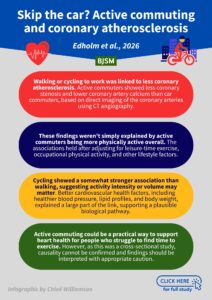
In simple terms, people who walked or cycled to work had less coronary stenosis on CCTA and lower coronary artery calcium than those who commuted by car. These associations remained after adjusting for confounders, including leisure-time exercise and occupational physical activity, suggesting the findings were not simply explained by active commuters being “more sporty” overall (See Figure 1).
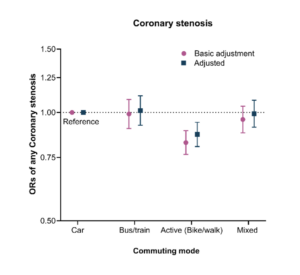
Figure 1. Associations of commuting mode with coronary stenosis in middle-aged adults. Binomial regression models with 95% CIs are shown. The basic model is adjusted for age, sex and site in SCAPIS, while the adjusted model includes additional adjustments for education, occupational physical activity and leisure time exercise habits, sleep, diet and smoking habits.
The association appeared somewhat stronger for cycling than walking, suggesting that intensity or volume of activity may matter. Interestingly, no independent association was found between active commuting and carotid plaques after full adjustment, pointing to possible artery-specific effects.
A large proportion of the association between commuting mode and coronary atherosclerosis was explained by better cardiovascular health factors, such as lower blood pressure, healthier lipid profiles, lower body mass index and less diabetes, among active commuters. This supports the biological plausibility of these epidemiological findings.
What are the key take-home points?
Active commuting, especially cycling, was associated with less coronary atherosclerosis, and this relationship appeared partly explained by better cardiovascular health factors. While the cross-sectional design limits causal conclusions, the findings suggest that active commuting could be a realistic way to reduce atherosclerosis and future cardiovascular events. For patients who struggle to “find time to exercise,” active commuting may offer a practical alternative.
Author information
Peter Edholm 1,2, Pontus Henriksson 1, Ángel Herraiz-Adillo 1
1 Department of Health, Medicine and Caring Sciences, Linköping University, Linköping, Sweden
2 Department of Environmental and Bioscience, Halmstad University, Halmstad, Sweden
X: @Peter_Edholm; @AdilloAngel; @P_Henriksson_
This blog provides an overview of a recently published study on the associations of active commuting and atherosclerosis (5).
References
- Martin SS, Aday AW, Allen NB, et al. 2025 Heart Disease and Stroke Statistics: A Report of US and Global Data From the American Heart Association. Circulation 2025;151(8):e41-e660. doi: 10.1161/cir.0000000000001303 [published Online First: 20250127]
- Frostegård J. Immunity, atherosclerosis and cardiovascular disease. BMC Med 2013;11:117. doi: 10.1186/1741-7015-11-117 [published Online First: 20130501]
- Ekelund U, Tarp J, Ding D, et al. Deaths potentially averted by small changes in physical activity and sedentary time: an individual participant data meta-analysis of prospective cohort studies. The Lancet 2026;407(10526):339-49. doi: https://doi.org/10.1016/S0140-6736(25)02219-6
- Hu G, Jousilahti P, Borodulin K, et al. Occupational, commuting and leisure-time physical activity in relation to coronary heart disease among middle-aged Finnish men and women. Atherosclerosis 2007;194(2):490-7. doi: 10.1016/j.atherosclerosis.2006.08.051 [published Online First: 20060918]
- Edholm P, Wennberg P, Ballin M, et al. Active commuting and atherosclerosis in a population-based sample of middle-aged adults: the Swedish CArdioPulmonary bioImage study (SCAPIS). Br J Sports Med 2026 doi: 10.1136/bjsports-2025-110403 [published Online First: 20260203]