Key words: Physical Therapy Modalities; Surgical Procedures; Systematic review.
Why is this study important?
Cryotherapy, the use of ice or cold for therapeutic purposes, is a widely used intervention in the rehabilitation and postoperative care of musculoskeletal injuries. Its popularity likely stems from being low-cost, easy to apply, and accessible for patients. Many recommendations in clinical practice rely on theoretical physiological mechanisms, and some guidelines still endorse cryotherapy on this basis (1, 2). However, the evidence regarding the effectiveness of cryotherapy on clinical outcomes is uncertain (3, 4). To better inform clinicians and patients, it is important to investigate the effectiveness of cryotherapy in postoperative musculoskeletal care, thereby understanding its clinical relevance.
How did the study go about this?
We conducted a systematic review of Randomised Controlled Trials (RCTs). Searches were conducted across four scientific databases: MEDLINE, COCHRANE, EMBASE, and PEDro. We included trials involving individuals recovering from musculoskeletal surgeries such as ligament reconstructions, arthroplasties, and arthroscopies, among others. In each study, the experimental groups received cryotherapy, while the comparison groups received identical care without the cold component.
We focused on clinical outcomes, including pain intensity, range of motion, swelling, and function, measured across four time points: immediate (up to 3 days after allocation), short-term (3 to 14 days), medium-term (14 days to 12 weeks), and long-term (>12 weeks). Using meta-analysis, we pooled effect sizes and evaluated whether these differences reach the level of clinical relevance based on the Minimum Clinically Important Difference (MCID).
What did the study find?
We included 28 RCTs. The results are summarised below, expressed as Mean Difference (MD) or Standardised Mean Difference (SMD), along with their respective 95% confidence intervals.
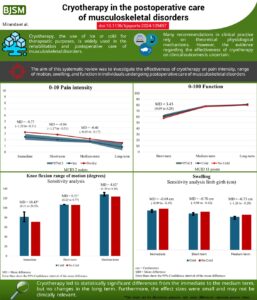
Pain intensity (0-10 scale, 0 meaning no pain and 10 worst pain)
- Immediate term: MD −0.77 (−1.23 to −0.31)
- Short term: MD −0.84 (−1.17 to −0.51)
- Medium term: MD −0.41 (−0.65 to −0.17)
These differences were statistically significant but did not reach the MCID of 2 points. There was no statistically significant difference in the long term.
Function (0-100 scale, higher values meaning better function)
- Short-term: MD 3.45 (0.69 to 6.20)
This difference was statistically significant but below the MCID of 11 points. There were no statistically significant differences in the medium- and long-term outcomes.
Range of motion
- Immediate term: SMD 0.37 (0.09 to 0.66)
- Short term: SMD 0.51 (0.25 to 0.77)
- Medium term: SMD 0.61 (0.04 to 1.18)
A sensitivity analysis including only studies evaluating knee flexion range of motion in degrees demonstrated the following results:
- Immediate term: MD 10.43° (0.31 to 20.55)
- Short-term: MD 0.51° (0.25 to 0.77)
- Medium-term: MD 4.82° (1.30 to 8.34)
Swelling
- Short term: SMD −0.35 (−0.64 to −0.05)
No statistically significant difference was found in either the immediate or medium-term. A sensitivity analysis including only studies evaluating limb circumference in centimetres showed reductions of:
- Immediate term: MD −0.69 cm (−0.99 to −0.39)
- Short-term: MD −0.70 cm (−0.98 to −0.42)
- Medium-term: MD −0.73 cm (−1.26 to 0.20)
What are the key take-home points?
Cryotherapy demonstrated statistically significant differences in pain intensity and range of motion from the immediate to the medium term. No statistically significant difference was found in any of the long-term outcomes. These effects may be too small to be considered clinically relevant, as the differences did not reach the MCIDs. Therefore, cryotherapy may not be an indispensable intervention in the postoperative management of musculoskeletal disorders due to its minor effect size and no impact in the long term. Its use must be carefully considered in terms of time, cost, patient preference, and the availability of alternative interventions with stronger evidence of effectiveness.
References
(1) Racinais S, Dablainville V, Rousse Y, et al. Cryotherapy for treating soft tissue injuries in sport medicine: a critical review. Br J Sports Med 2024;58:1215–23.
(2) Vuurberg G, Hoorntje A, Wink LM, et al. Diagnosis, treatment and prevention of ankle sprains: update of an evidence-based clinical guideline. Br J Sports Med 2018;52:956.
(3) Miranda JP, Silva WT, Silva HJ, et al. Effectiveness of cryotherapy on pain intensity, swelling, range of motion, function and recurrence in acute ankle sprain: A systematic review of randomized controlled trials. Phys Ther Sport 2021;49:243–9.
(4) Aggarwal A, Adie S, Harris IA, et al. Cryotherapy following total knee replacement. Cochrane Database Syst Rev 2023;9:CD007911.
Author and affiliations
Júlio Pascoal de Miranda
Postgraduate Program in Rehabilitation and Functional Performance, Universidade Federal dos Vales do Jequitinhonha e Mucuri, Diamantina, Brazil. http://orcid.org/0000-0002-7125-8813
Rafaela Calixto Cortez Figueiredo
Postgraduate Program in Rehabilitation and Functional Performance, Universidade Federal dos Vales do Jequitinhonha e Mucuri, Diamantina, Brazil
Bruno Tirotti Saragiotto
Discipline of Physiotherapy, University of Technology Sydney, Sydney, New South Wales, Australia. http://orcid.org/0000-0003-4409-8057
Vinícius Cunha Oliveira
Postgraduate Program in Rehabilitation and Functional Performance, Universidade Federal dos Vales do Jequitinhonha e Mucuri, Diamantina, Brazil. http://orcid.org/0000-0002-8658-3774