Female, woman, and girl sport has never been more visible (1). This rise in popularity is accompanied by increasing injury rates (2). This blog gives a summary of a recent systematic review done to identify prevention strategies and risk factors for female/woman/girl athletes spine, chest, abdominal and/or pelvic injury/pain (3), which informed the International Olympic Committee Female woman and girl Athlete Injury pRevention (FAIR) Consensus (4).
Why is this study important?
Many female/woman/girl athletes experience sport-related spine, chest, abdominal and/or pelvic injury/pain. Despite this, evidence about why these injuries/pain occur and how prevent them is sparse. This knowledge gap may be a result of under-reporting and/or an overreliance on male/man/boy or combined data. It is also unclear if there are sex- or gender- specific prevention interventions and risk factors for spine, chest, abdominal and/or pelvic injury and pain. Not having this information can lead to misguided ideas that overemphasise biological explanations (e.g. body composition or hormonal factors as root causes) or overlook environmental factors that may disadvantage female/woman/girl athletes (e.g. resource availability, less training time and support). Past studies designed to assess prevention interventions and identify risk factors, might provide clues. Systematic reviews combine the findings from several studies, providing high-level evidence.
What did we do?
This systematic review included any study that assessed a prevention intervention, or modifiable risk factors for female/woman/girl athlete’s spine, chest, abdominal and/or pelvic injury or pain, relative to a comparison group. We searched nine databases for eligible studies and assessed risk-of-bias, performed quantitative (meta-analysis) and semi-quantitative syntheses, and reached a conclusion and level of evidence for individual intervention or modifiable risk factor when data were available.
What did the study find?
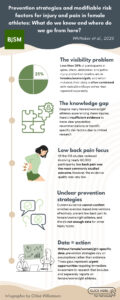
We included 105 studies involving 59,833 participants (24% female/women/girls), with 33% reporting female/women/girl specific data. Based on the female/woman/girl data, nine injury/pain outcomes were assessed, the most common being low back pain (LBP). There were enough studies to perform meta-analyses for body mass, body mass index (BMI), weekly training hours, and spinal flexion as risk factors for LBP, and semi-quantitative analyses for exercise to prevent LBP, as well as yearly training load, hip motion, and hip strength as risk factors for LBP.
The clinical value of all the risk factors was unclear because of the very-low certainty evidence of the included studies. Based on the past evidence, it was also unclear if exercise-based interventions can prevent female/woman/girl athlete LBP. Finally, there was not enough female/woman/girl specific data to make conclusions about risk factors or prevention strategies for other types of spine, chest, abdominal, or pelvic injury/pain.
What are the key take-home messages?
This review shines a crucial spotlight on alarming knowledge gaps related to a category of sport-related injuries and pain that reflect the specific needs of female/women/girls.
- Female/woman/girls athletes represent less than 25% of participants in studies that inform the prevention of spine, chest, abdominal and/or pelvic injury/pain.
- When female/woman/girl athletes are included in research, many studies only report data combined with males/men/boys.
- The omission of female/woman/girl athletes in injury prevention limits our ability to make informed, gender- and sex- specific injury prevention recommendations for female/woman/girl athletes.
This review reminds us that data matters. They confer visibility, legitimacy, and funding. When female/woman/girl athlete injury and health experiences are invisible, prevention strategies default to assumptions. These gaps represent significant opportunities that require immediate action and investment.
References
- Women’s Sport Alliance. The Numbers that made 2024 the Biggest Year for Women’s Sport Ever. What’s New. 2024. https://www.wsportsalliance.com/post/the-numbers-that-made-2024-the-biggest-year-for-women-s-sport-ever
- Tanaka MJ, LiBrizzi CL, Rivenburgh DW, Jones LC. Changes in U.S. girls’ participation in high school sports: implications for injury awareness. Phys Sportsmed. Nov 2021;49(4):450-454. doi:10.1080/00913847.2020.1852861
- Whittaker JL, Schulz JM, Galarneau JM, et al. Prevention strategies and modifiable risk factors for spine, chest, abdominal and/or pelvic injury and pain: a systematic review and meta-analysis for the Female, woman and girl Athlete Injury pRevention (FAIR) consensus. Br J Sports Med. Aug 31 2025:bjsports-2025-1. doi:10.1136/bjsports-2025-109900
- Crossley KM, Whittaker JL, Patterson B, et al. Female, Woman, and/or Girl Athlete Injury pRevention (FAIR) Practical Recommendations: International Olympic Committee (IOC) Consensus Meeting Held in Lausanne, Switzerland 2025. Br J Sports Med. under review;
Authors:
Jenna Schulz [1,2]
Kathryn Dane [3]
Hana Marmura [4]
Jackie L. Whittaker [1,2]
Affiliations:
- Department of Physical Therapy, Faculty of Medicine, University of British Columbia, Vancouver, Canada
- Arthritis Research Canada, Vancouver, Canada
- Sport Injury Prevention Research Centre, Faculty of Kinesiology, University of Calgary, Calgary, Canada
- College of Arts and Sciences, The University of North Carolina, Chapel Hill, United States
X handles:
@jwhittak_physio
@jennaschulz_1
@KathrynDane2
@HanaMarmura