Why is this study important?
Following the 2020 Netflix documentary “Athlete A,” hundreds of former elite gymnasts have come forward with accounts of psychological and physical violence, sexual harassment/abuse, and organizational neglect. While research has identified these experiences as abusive, we have lacked a comprehensive understanding of their potential long-term consequences. This study fills this gap by providing a systematic overview of how interpersonal violence (IV) affects retired gymnasts.
For clinicians, this research reveals that the impact of IV extends far beyond what we might typically expect. The study identifies 54 distinct negative outcomes and 7 potentially positive outcomes that can emerge even decades after retirement. Understanding these patterns helps clinicians recognize, assess, and treat the complex presentations they may encounter when working with former gymnasts.
The research also demonstrates that recovery is possible, particularly when victims/survivors can recognize their experiences as abusive and find their voice through supportive communities and public discourse.
How did the study go about this?
The study was conducted as a trauma-informed qualitative study, interviewing 19 former elite gymnasts (18 artistic, 1 rhythmic) aged 20-53 from 12 countries across four continents. Participants were recruited purposefully through social media following the #gymnastalliance movement.
The online interviews (90-240 minutes) followed a life-history approach, which allowed participants to share their experiences in their own words. The study used a hybrid data analysis approach, first identifying the potential outcomes described by the participants and then mapping these against the 2024 IOC consensus statement on IV.
What did the study find?
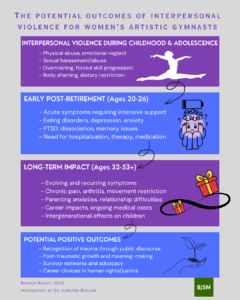
The findings are both extensive and sobering. The former gymnasts described extensive polyvictimization during their formative years, with coaches identified as the primary perpetrators. The participants related their experiences to 54 different negative outcomes:
Psychological outcomes included memory loss, dissociation, flashbacks, depression, anxiety disorders, PTSD, and body image disorders. Participants described having no positive memories of gymnastics and feeling betrayed by the sport they once loved.
Behavioral outcomes encompassed eating disorders, relationship difficulties, social isolation, and concerning patterns like avoiding placing their own children in gymnastics or developing “helicopter parenting” behaviors.
Physical outcomes were dominated by chronic pain from training-related injuries, arthritis, and movement restrictions. Some participants required reconstructive surgery or experienced ongoing disability from gymnastics-related IV.
Material/performance outcomes included poor academic performance, difficulty choosing careers, loss of gymnastics-related employment, and medical costs.
A crucial finding was the outcomes temporal nature. Recently retired gymnasts (aged 20-26) experienced more acute symptoms requiring intensive support, including hospitalization and service animals. Older participants (32-53) reported that the outcomes evolved over time, with new problems emerging related to parenting concerns and worsening physical health.
However, the study also identified 7 positive outcomes, including post-traumatic growth, strong advocacy networks among survivors, and career choices focused on human rights and justice.
What are the key take-home points?
For immediate clinical practice:
- Screen former gymnasts for complex, interconnected trauma presentations rather than single diagnoses
- Expect different presentations based on time since retirement: acute symptoms in recent retirees, evolving/recurring issues in long-term survivors
- Recognize that chronic pain may be trauma-related, not just sports injury-related
- Be prepared for eating disorders, relationship difficulties, and parenting anxieties
For treatment approaches:
- Use trauma-informed, multidisciplinary care models
- Provide validation of abuse, this is often the first step toward recovery
- Address both psychological and physical health impacts simultaneously
- Plan for long-term, evolving care needs rather than short-term interventions
For advocacy and prevention:
- Support public discourse about IV in sport/gymnastics
- Understand that speaking out about abuse can be both healing and re-traumatizing
- Press gymnastics/sports organisations to transform their structures and processes to safeguard gymnasts/athletes and provide independently (co)funded care
The research demonstrates that IV creates a “gift that keeps on giving” throughout victims/survivors’ lives. However, it also shows that with proper recognition and support, resilience can develop and turn into powerful advocacy for change.
Author Natalie Barker-Ruchti, School of Health Sciences, Örebro University, Sweden
References
Barker- Ruchti N. Researching abuse in women’s artistic gymnastics: a trauma- informed approach. In: McMahon J, McGannon G, eds. Trauma- Informed Research in Sport, Exercise, and Health. London: Routledge, 2024: 123–40.
Barker- Ruchti N, Varea V. Surviving child sexual abuse in women’s artistic gymnastics: ’it’s beautiful, because had I stayed in the past, I wouldn’t have evolved as a person’. Int Rev Sociol Sport 2024; 59:660–78.
Mountjoy M, Adriaens K, Junge A, et al. Association of self- reported health problems and interpersonal violence in sport: a cross- sectional study in world- level performing athletes. Br J Sports Med 2024; 58:1360–8.
Stewart C, Barker- Ruchti N. Unraveling gender and non- accidental violence in women’s gymnastics research: a critical interpretive synthesis. Quest 2024; 76:169–89.
Tuakli- Wosornu YA, Burrows K, Fasting K, et al. IOC consensus statement: interpersonal violence and safeguarding in sport. Br J Sports Med 2024; 58:1322–44.