Keywords: Relative energy deficiency in sport, muscle, strength
Why is this study important?
Low energy availability, or an imbalance between nutritional intake and physical activity, is a common health concern among male and female athletes. Low energy availability is known to negatively affect muscle strength, athletic performance, and overall neuromusculoskeletal health. Recent studies have begun to show that low energy availability may also reduce expected neuromusculoskeletal responses to physical exercise and training (for example, minimal strength gains in response to resistance training). This systematic review sought to compile the existing evidence about neuromusculoskeletal responses to training among individuals with low energy availability.
How did the study go about this?
The study team searched for published studies that assessed any neuromusculoskeletal outcome (i.e., strength, performance) after a physical training intervention of any type or duration among individuals with low energy availability. The search spanned across six databases, and sets of two reviewers screened 3,388 articles by title, abstract, and full text as needed to determine if they would fit the study question. The research team reviewed each included study to determine low energy availability status, the types of training interventions, and neuromusculoskeletal outcomes. Unfortunately, there were differences in research methods across studies, and so it was not possible to look at combined neuromusculoskeletal outcomes. However, the research team looked at common findings across studies to provide the best current evidence.
What did the study find?
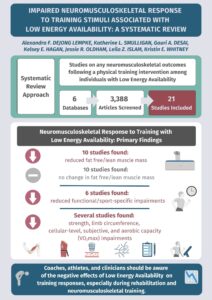
There were 21 studies included in the review. Nine studies directly prescribed the physical training, which often included endurance-based activities (i.e., running, cycling) at a moderate intensity. The most consistent findings across all included studies were that low energy availability led to a decrease in lean muscle mass (or fat-free mass) following a physical intervention (found in 10 studies), or that there was no major response in lean muscle mass to training (found in 10 studies). Six studies found that those with low energy availability had impaired functional or sport-specific performance (for example, slower performance on a timed 2-mile run test). Several other studies looked at strength and other neuromusculoskeletal health/performance outcomes, and all found that those low energy availability had impaired outcomes in response to training.
What are the key take-home points?
Overall, the current evidence shows that low energy availability may either lead to worse neuromusculoskeletal outcomes in response to training, or that low energy availability may blunt training responses with minimal changes in desired adaptations over time. Coaches, athletes, and clinicians should be aware of the current threats to training responses associated with under-fueling to achieve desired responses to physical training, sport, and exercise.
Authors:
Alexandra F. DeJong Lempke; Katherine L. Smulligan; Gauri A. Desai; Kelsey E. Hagan; Jessie R. Oldham; Leila Z. Islam, Kristin E. Whitney.
References:
Mountjoy M, Ackerman KE, Bailey DM, Burke LM, Constantini N, Hackney AC, et al. 2023 International Olympic Committee’s (IOC) consensus statement on Relative Energy Deficiency in Sport (REDs). Br J Sports Med. 2023;57:1073–97.
Oxfeldt M, Phillips SM, Andersen OE, Johansen FT, Bangshaab M, Risikesan J, et al. Low energy availability reduces myofibrillar and sarcoplasmic muscle protein synthesis in trained females. J Physiol. 2023;601:3481–97.
Areta JL, Burke LM, Camera DM, West DWD, Crawshay S, Moore DR, et al. Reduced resting skeletal muscle protein synthesis is rescued by resistance exercise and protein ingestion following short-term energy deficit. Am J Physiol Endocrinol Metab. 2014;306:E989-997.
Pasiakos SM, Vislocky LM, Carbone JW, Altieri N, Konopelski K, Freake HC, et al. Acute energy deprivation affects skeletal muscle protein synthesis and associated intracellular signaling proteins in physically active adults. J Nutr. 2010;140:745–51.
Tornberg ÅB, Melin A, Koivula FM, Johansson A, Skouby S, Faber J, et al. Reduced Neuromuscular Performance in Amenorrheic Elite Endurance Athletes. Med Sci Sports Exerc. 2017;49:2478–85.