Authors:
Why is this study important?
Knee injuries are the highest burden match injury location in professional rugby, as they are both common and severe (1), and consequently can lead to long recovery times, significantly impacting players’ careers (2). This study provides a comprehensive analysis of knee injuries in English professional men’s rugby union over 20 years, helping to identify trends and inform future injury prevention strategies.
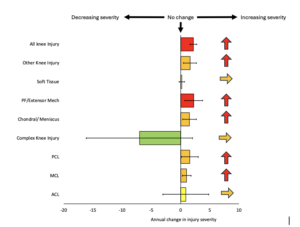
Figure 1: Annual change in injury severity by injury type. Arrows indicate either a significantly increased risk (red arrow) or no significant difference (orange arrow).
How did the study go about this?
Team medical staff collected injury data from the highest level of men’s rugby in England (The Premiership) over 20 seasons (2002–2023). The research team analysed the number of knee injuries, the type of injury, how long players were sidelined, and whether playing surfaces (natural grass vs. artificial turf) affected knee injury rates. Data was gathered from club medical teams and categorized based on injury type, severity, and the event during which the injury occurred, such as tackles, running, or rucks. The study also analysed trends over time to determine whether knee injury rates and severity were increasing, decreasing, or had remained stable. This large-scale approach allows for a more comprehensive, long-term understanding of knee injuries in professional rugby.
What did the study find?
Despite advancements in training, medical support, and injury prevention strategies, over 20 years there has been no change in overall knee injury counts (Figure 1). Conversely, unchanged knee injury rates may suggest these advancements have positively offset the rates, given the increase in the games physicality, the rise in ball-in-play time, and a the increase in the number of contact events, The severity of knee injuries has increased (Figure 1), meaning that injured players are missing more time from the game than in previous years. Medial collateral ligament (MCL) injuries were the most common, often occurring due to tackles, while anterior cruciate ligament (ACL) injuries were the most severe, typically requiring the longest recovery time (2) (Figure 2). ACL injuries, though less frequent than MCL injuries, have a major impact on players’ careers due to their high severity and lengthy rehabilitation periods. Additionally, the study found that the incidence of knee injuries was 44% higher on artificial grass pitches compared to natural grass (2) [one knee injury every 1.9 games (152 mins) compared to one every 2.7 games (216 mins): Figure 3]. This finding contrasts with the rate of all injury types, which shows no significant difference between surface types (3). The difference in knee injury rates between surfaces suggests that further research is needed to assess how pitch conditions affect player safety, for example how changing surface from one week to the next influences injury risk. Another key finding was that tackling was the primary cause of knee injuries in matches, particularly for the player being tackled.
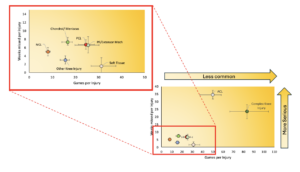
Figure 2: Risk matrix showing commonality (games per injury) and severity (weeks missed) of knee injuries by type.
What are the key take-home points?
The study highlights that knee injuries are a persistent challenge in professional rugby, with increasing severity despite the evolution of player conditioning, rehabilitation, and focus on safety. The higher risk of knee injuries on artificial turf demonstrates the need for further investigation of surface types (e.g. the influence of weekly surface changes). Given that tackling is the most frequent cause of knee injuries, particularly for the tackled player, the findings suggest that injury prevention strategies should focus on both technique and game regulations to reduce dangerous impacts that result in knee injury. The nature of rugby means that high-impact collisions are inevitable, but small adjustments to technique and rule enforcement could make a significant difference. These findings underscore the importance of ongoing research into injury prevention to enhance player welfare.
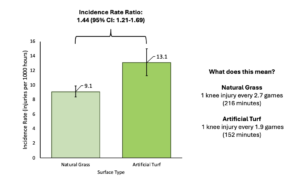
Figure 3: Incidence rate and incidence rate ratio of knee injuries on natural grass and artificial surfaces.
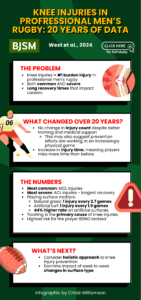
Figure 4: Infographic summarising study
References:
- West SW, Starling L, Kemp S, et al. Trends in match injury risk in professional rugby union: A 16-season review of 10851 match injuries in the English Premiership (2002-2019): The Professional Rugby Injury Surveillance Project. British Journal of Sports Medicine. 2020;55:676-682. doi:DOI: 10.1136/bjsports-2020-102529.
- West SW, Hudson SJ, Starling L, et al. Twenty year analysis of professional men’s rugby union knee injuries from the English Premiership shows high rates and burden. British Journal of Sports Medicine. 2024;Online first
- Robertson CM, Williams S, West SW, Starling L, Kemp S, Cross M, Stokes KA. Influence of playing surface on match injury risk in men’s professional rugby union in England (2013-2019). Scand J Med Sci Sports. 2022 Nov;32(11):1615-1624. doi: 10.1111/sms.14226. Epub 2022 Sep 4. PMID: 36004455; PMCID: PMC9825862.