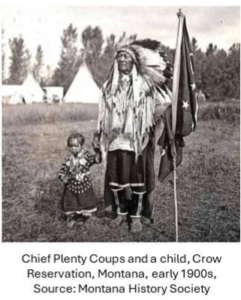
Shortly before he died in 1932, Chief Plenty Coups, the last great chief of the Native American Crow tribe, told his story to a white man, Frank B Linderman, a ‘sign talker’’ who could record Crow history for both their peoples.
A turn-of-the-20th century tribal leader might seem an unlikely source of inspiration for modern health and care leaders, struggling to meet targets and deliver efficiencies. Yet we also now find ourselves at an inflection point, a moment where our current systems and structures are failing, where different forms of leadership may be required to help us reinvent ourselves.
Plenty Coups became the Crow leader in the 1870s, when he was in his late 20s. His story to Linderman describes the exploits of a tribe of nomadic hunters, dreams and rain dances, hunting buffalo and military feats against the Sioux and other tribes.
Linderman’s account documents the end of a civilisation, as the Crow transitioned to existence on a reservation. “When the Buffalo went away, the hearts of my people fell to the ground, and they could not lift them up again. After this, nothing happened.”
The philosopher Jonathan Lear argues that this statement can be understood literally. What can ‘happen’ when all the practices of tribal life – organised around hunting and warfare – have been stripped of meaning. After the Great War, Plenty Coups represented Native American soldiers at the tomb of the unknown soldier in Washington. At the end of the ceremony, he took off his war bonnet and placed it on the coffin, before laying his coup stick on top. These totems had no authenticity in the modern world.
Yet something did happen. The Crow had a practice for pushing at the limits of their understanding: they encouraged young members of the tribe to go into nature and dream, in isolation and exposed to hardship, before a collective process of sensemaking and storytelling.
As a child in the 1850s, Plenty Coups had set off into the wilderness to do so. His dream, interpreted by elders and iterated over time, captured the tribe’s anxiety about the arrival of European settlers and foresaw the end of their way of life. It also began the process of envisaging a different future. “By listening as the Chickadee listens, we may escape [defeat] and keep our lands.” (Modern neuroscience is now of course unpicking the role of dreaming in creativity.)
From the mid-1800s, Plenty Coups built an alliance with the US Government in exchange for reserved Crow territories. In the early 1900s, he successfully fought legislation to open these territories to white settlement. He encouraged his people to embrace agriculture. He negotiated the establishment of new schools on Crow lands. “With what the white man knows, he can oppress us. If we learn what he knows, he can never oppress us again.”
Health leaders do not bear the same responsibilities of tribal leaders in 19th century America. But their choices often determine who lives and who dies. Their courage and creativity – the presence or the lack of it – shapes whether people can live good lives.
In a speech to the NHS confederation in 2022, Hilary Cottam highlights the similarities between the challenges faced by Plenty Coups and his people and those faced by struggling communities in the UK and our welfare services. “I’m not necessarily arguing that we are at time of cultural collapse although it seems likely that we are on the verge of eco-collapse and we are in a deep state of health collapse: of physical and nervous exhaustion. Many, many health workers feel this collapse and they are voting with their feet.”
So the model of leadership outlined briefly here feels relevant for modern healthcare. How can we cultivate health leaders with the virtues, capabilities, creative capacity and breadth of life experience needed to chart a course through crisis? Jonathan Lear summarises the type of leadership and creativity needed in moments of profound transition: “At a time of cultural collapse, the courageous person has to take a risk on the framework itself”.
Plenty Coups did not turn the tide of history. The forces at work were too powerful. He did however navigate a transition for his people, avoiding despair and framing new ways for the Crow to live good lives. The Crow did escape defeat. And they did retain their lands.
Taken from Jonathan Lear’s ‘Radical Hope: Ethics in the Face of Cultural Devastation’ (2006)
Leading Across the Commonwealth and Beyond captures vital conversations between global health leaders and emerging voices. In this blog, we explore how to redefine how we lead with compassion, connectivity, and courage in an increasingly complex world.
Author
Ben Collins
Ben is an NHS manager and a senior associate at the King’s Fund. In his current role, he develops new model of integrated care for people with frailty and complex needs in North West London.
Declaration of Interests
No conflicts of interest to disclose