“The migrants are coming.”
This is the opening sentence of my recent TEDxNHS Talk. A warning we’ve heard many times now.
It’s a line designed to provoke, because the debate on migration has become saturated with fear, slogans, and political noise. Yet behind those headlines are real people whose health needs don’t pause at borders. And as leaders in health and care, should it not be us that decides what we stand for?
To me, leadership in healthcare is ultimately about who we choose to see — and who we allow to remain invisible.
I’ve learned this not from theory, but from the sharp end of humanitarian work. As the lead medical doctor on a search-and-rescue mission in the central Mediterranean, I witnessed how rapidly life can unravel when systems fail the most vulnerable.
One dawn, as our ship approached multiple dangerously overcrowded small boats, dozens of tiny reflections stared back at us from the darkness — the glaring eyes of people who had been drifting for days. That morning shaped my understanding of leadership more than any textbook.
I won’t retell the entire story here — that’s what the TED talk is for — but the essence matters. The ability to make critical decisions under pressure isn’t just clinical; it’s moral.
When we requested a medical evacuation for a critically unwell child in the middle of the sea, I wasn’t thinking in abstractions. I was thinking about responsibility. About visibility. About what happens when someone’s life depends on a leader choosing not to look away.
When politics shapes perception, clinical leadership must hold its ground
Migration is now one of the most politicised issues of our time. Groups of people — migrants, refugees, asylum seekers — are routinely scapegoated, reduced to threats, numbers, or burdens. Entire narratives are built around what they supposedly take from us.
But leadership demands steadier thinking. When public narratives grow louder, clinical leadership must grow clearer.
When polarisation deepens, our duty to impartial and inclusive care must sharpen. Health professionals cannot control political rhetoric, but we can model a different kind of leadership — one built on evidence, compassion, and a refusal to dehumanise.
This isn’t a political stance; it’s a professional one.
And it extends far beyond migration.
The unseen groups growing at the edges of our system
Across the UK, a widening circle of people are slipping into invisibility. Some of the groups I’ve encountered clinically and through humanitarian work include:
- people experiencing homelessness
- survivors of human trafficking
- victims of domestic abuse
- victims of organ trafficking (organ theft)
- women affected by Female Genital Mutilation (FGM)
- people in exploitative sex work
- unaccompanied minors
- undocumented migrants
- rough sleepers and modern-slavery survivors
These groups are not small. They are growing. They experience higher morbidity, worse access, and significantly poorer outcomes. And when they remain unseen, the consequences ripple back into the health and care system — emergency attendances, safeguarding failures, complications from untreated illness, and long-term social harm.
In other words: ignoring vulnerable groups is not just unethical — it is operationally expensive.
This is not something most clinicians are trained for.
I was never properly taught about human trafficking, modern slavery, illicit organ harvesting, FGM, or the health realities of exploitation. Most clinicians weren’t.
Yet safeguarding reviews repeatedly show that the warning signs were present long before intervention. We cannot expect the workforce to respond confidently to hidden harms if we continue to treat this education as optional.
This is one of the reasons I founded courses that support clinicians to understand — to offer structured, practical training for clinicians who want to practise safely and compassionately in an era of global displacement and rising vulnerability.
Training is not a “nice to have” anymore. It is a core leadership skill.
Leadership in action: what we must do next
To lead effectively in today’s climate, health and care leaders need to:
- Model moral courage — challenge dehumanising narratives when you hear them.
- Create environments where vulnerability is recognised early, not accidentally discovered.
- Equip teams with the skills to identify exploitation, trauma, and hidden harm.
- Protect spaces for nuanced conversations, especially when politics becomes polarised.
- Advocate for systems that include the unseen, because exclusion always costs more later.
- Use your platform — whether in the NHS, academia, policy, or clinical practice — to influence culture, not just process.
These aren’t lofty ideals. They are tangible leadership behaviours that shape safety, equity, and trust.
A profession that decides who it sees, decides who it saves
As I say in my TED talk: “We wouldn’t hesitate to resuscitate a child in a hospital bed. So why would we hesitate when that same child is pulled from the sea?”
If we, as leaders and clinicians, choose to look away from the hardest stories — the ones that sit far from our waiting rooms — we unintentionally endorse a hierarchy of human value. That is not the NHS I joined. It is certainly not the NHS future generations deserve.
My call to leaders is simple:
- Take notice.
- See the people the headlines forget.
- Train teams to recognise hidden harm.
- Stand firm when politics tries to reshape professional duty.
- Lead with clarity, not fear.
Migrants are coming — but they always have been.
And for their sake, and ours, we have a responsibility to get this right — not just clinically, but morally.
Further Resources
- Healthcare in Hidden Communities: Why It’s Everyone’s Problem | Priyesh Patel | TEDxNHS
https://youtu.be/zc76uleTg4s?si=KlKbA4nL_kkTFCQ_
A deeper exploration of the stories, leadership lessons, and ethical questions underpinning this piece.
- Training programmes on Medical and Humanitarian Migration, Exploitation and Safeguarding:
https://www.neglectedelements.com
CPD Courses designed to equip clinicians and frontline professionals with the skills and confidence to identify and support vulnerable groups.
Author
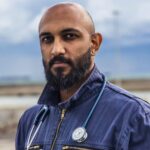
Dr Priyesh Patel is an NHS Emergency Medicine doctor and the CEO of Neglected Elements, an organisation dedicated to improving education on humanitarian health, migration, and exploitation. He has worked across the UK and internationally, including serving as the lead medical doctor on a Mediterranean search-and-rescue mission, and now develops training programmes to help clinicians support vulnerable and marginalised groups.
Declaration of interests
I have read and understood the BMJ Group policy on declaration of interests and declare the following interests: none.