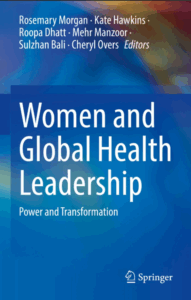
 When I picked up “Women and Global Health Leadership” to read, I had a simple wish: to find out how women in leadership got to where they are, what inspired them, and if they had any regrets about building their careers alongside raising a family. But the book did more than that; it helped me to understand my role in building other leaders and the value of having a supportive peer group.
And so, to the review:
A phrase we often hear is that there needs to be diversity and representation in the workforce, especially in leadership, where decisions are made. The statistics of how women are underrepresented and the fact that in some fields we still have ‘the first female to…’ even in this age are well-known. To me, there remains a narrative that advocating for equal representation is just for feminists and perhaps not always seen as good.
But this book provides answers to anyone who is confused about why we need to repeatedly emphasise the need for diversity and inclusion of women in leadership. It’s a great place to start if you are an ally interested in making this happen or genuinely want to understand what female leadership means, its impact, and its challenges.
The international lens of this book offers authors drawn from across the globe (in both the Global North and South) along with real-life interviews with women from different countries; recognising that there are lessons to be learnt from around the world.
The book begins, helpfully, by setting out the problem then exploring different themes and what we can do differently. Readers are invited to review what we consider leadership, challenging the use of terms that are generally viewed as masculine in the definition of leadership. It inspires thoughts on how we can challenge or change the current leadership structure to ensure it is inclusive and gender-neutral. It encourages the reader to see good leadership as that which seeks to ‘change the system, inspire and aims to improve the team and work capabilities’. It emphasises that leadership is not just one style.
Importantly, the book does not shy away from tough questions. Such as why women’s leadership has been so elusive in a field that is heavily reliant on women’s labour (approximately 70% of the global health workforce, yet women account for only 25% of leadership roles). It explores sensitive themes such as the impact of sexual abuse on the workforce, but it also goes further to explore some of the barriers that prevent women from ‘rising to the top’ or being recognised for their endeavours, noting that these point to deeper norms (cultural, social, political, and economic) which cannot be tackled in isolation.
What I found most helpful is that between the chapters is an interview with successful women who are leaders from diverse areas around the world and with varied leadership trajectories. The interviews offer candid insight for women who want to lead or for anyone who wants to support women in leadership. These real-life experiences help the reader understand how women can navigate leadership challenges as well as what makes leadership different for women. It touches on sensitive issues like sexual abuse and the tactics used to devalue women in leadership. The insightful nuggets these women share about their leadership journey have some similarities. For most, it started from childhood – what they saw as children shaped their experiences. Some of these women had the opportunity to be mentored or sponsored by others. A community or sisterhood was also commonly articulated. Others offered stories of less conventional routes to leadership, such as leading through their writing. I found it both reassuring and wholesome to learn that we can each lead from our own place.
This book also reminds us why we should commit to creating a safe place for the girl child and, indeed, any child (regardless of their protected characteristics) to grow, so they are not only surviving as children but thriving. It brings to the forefront the value of apprenticeships and mentorship. It guides us on the impact of allowing others to step into the room or us being the friendly voice or face in the room, welcoming others; and to lift as we climb. By acknowledging the impact of gender on leadership and creating awareness that leadership can take different forms, and that both women and men can lead, albeit in different ways, it creates an opportunity for conversations about existing gender biases. My favourite quote was that “leadership is not grey hair”, and it served as a reminder to me that as I ascend the path of leadership, as much as I look up to people to mentor and guide me, I should also make it a duty to mentor and guide those following in my footsteps.
The chapter on academic status stood out to me as a woman from an LMIC, where there are difficulties in accessing research, which has a profound influence on career success. It acknowledges the “publish or perish” phenomenon in the global health world and highlights the uneven playing field that exists between researchers from high-income countries and those from low- and middle-income countries in accessing research funding and support; something that clearly needs more attention.
The book (unsurprisingly) included numerous statistics and quotes from scientific journals, with quite an academic tone, and although it makes the writing more credible, for those less accustomed to academic writing – it may be less appealing.
However, I would still highly recommend the book as it encourages society to do a ‘better job of demonstrating that women’s leadership and the advancement of women is a legitimate and critical issue that we need to tackle as a community and as a society’. I resonated deeply with the idea that we can only change our society by first changing ourselves, and then our institutions to reflect the practical changes that encourage women in leadership. This book is a worthwhile read for those keen to create space for collaboration and interested in promoting women’s leadership; as whilst there are many stories of progress, there is, clearly, still much more we can do.
Author
Dr. Dyanne Imo-Ivoke
Dr Imo-Ivoke is a neonatal resident doctor working in Bristol. She has a focus on leadership and medical education. She worked as a Future Leaders Fellow in 2024 and sees leadership as an essential skill for professionals. She has a desire to improve neonatal outcomes, especially in LMIC.
Declaration of interests:
I have read and understood the BMJ Group policy on declaration of interests and declare the following interests: None.