Four years ago, I was a clueless first-year undergraduate navigating an entirely new academic structure during a global pandemic. It was 2021, and classes were conducted entirely online due to COVID-19. At the National University of Singapore, I was part of the newly established College of Humanities and Sciences, born from the merger of the Faculty of Arts and Social Sciences and the Faculty of Science. Being in the pioneer batch meant charting unknown territory with no guidance from seniors, whilst the shift to remote learning only amplified the challenge. Although the college organised virtual freshmen camps, the relationships forged through screens were too brief to last.
Over that first year, I gradually developed the skills to navigate the system independently. Entering my second year with a clearer understanding of curriculum requirements, I decided to pursue a minor in public health alongside my life sciences major. Very timely, a public health challenge caught my eye – the topic was social isolation. I immediately recognised an opportunity to address the struggles I had faced firsthand. I rallied three friends to join me in tackling the isolation experienced by pioneer students, exacerbated by the pandemic’s constraints.
We activated over a hundred pioneer students through a group chat, surveying their experiences navigating our new college structure. The results were astounding – an affirmation that I was never alone. Their voices amplified mine and served as strong testament for change. Our research identified a critical gap: when students experienced social isolation, they lacked opportunities for meaningful interaction beyond online classes, making system navigation feel particularly unguided. We proposed a social mentorship model pairing senior students with groups of ten freshmen for informal check-ins and guidance.
Our case secured second place, earning us a monetary prize as recognition for our work. However, unlike the first-place winners who received implementation support on top of the prize money to pilot their solution within the university, our award came without any pathway to actually test or implement our proposed mentorship model. I had hoped we would have the opportunity to sit down with the judges to understand their thought process behind their evaluation and learn how we could improve our approach. Without this feedback, we felt lost and uncertain about how to strengthen our proposal or move forward. The experience was bittersweet – while the challenge provided a platform for us to raise awareness and helped build a sense of solidarity among my peers, it did not allow space for the solution to be implemented.
It became clear that meaningful initiatives require more than identifying problems and amplifying voices – they demand suitable solutions and sustainable support systems for implementation. This lesson now guides my work at the Centre for Healthcare Innovation (CHI), where I’ve found that healthcare innovators face strikingly similar challenges – they are brilliant minds with problems and ideas, yet lack sufficient platforms to foster their ideas into action.
Where I once craved spaces that would enable people, I now work with my team to create platforms that enable others to connect, learn, and move ideas into action: an online knowledge management repository to enable knowledge exchange, an annual healthcare conference to spark discourse, a faculty group to promote collaborative problem-solving, and publishing thought leadership papers to share best practices widely. For experts and ground practitioners alike, these platforms provide opportunities to share not only their successes but also their failures and lessons learnt, imparting valuable knowledge to other innovators driving change and making learning and mentorship an open resource. In healthcare, providing robust platforms for innovators can mean the difference not just between one patient and another, but between one health system the next.
As a young leader who has experienced both sides of this equation, I found the inaugural FLYING summit to be a remarkable platform. Co-hosted by the Centre for Healthcare Innovation’s Future Leaders and Young Innovators Guild (CHI-FLYING) and the Commonwealth Leadership Institute (CLI) in Singapore, the summit convened young leaders under 40 around the theme “Health is Social.” It served as a rallying call for future leaders and innovators in health and social spaces to build, transform, and lead tomorrow’s health systems.
The summit’s workshops, led by Prof. Hahrie Han from Johns Hopkins University and facilitators from the Lee Kuan Yew School of Public Policy, exemplified the platform I had once sought as a student. Beyond allowing voices to inspire, the workshops also supported meaningful action by building capabilities. Young leaders were not only invited to envision transformative possibilities but also equipped with practical toolkits and frameworks necessary for sustainable change. Many platforms encourage us to innovate and drive change but rarely provide the support to do so effectively.
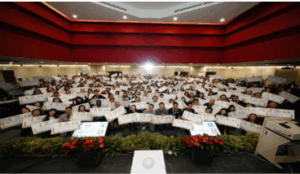
Participants holding their pledge at the FLYING Summit 2025.
This FLYING summit brought my journey full circle and crystallised the qualities of a good platform. Where I once prioritised gathering voices, I now focus on creating pathways for those voices to generate lasting change by equipping them with tools, frameworks, networks and sustained mentorship support needed to begin carrying their ideas forward. This evolution reflects a broader shift in my perspective as a young leader – from believing that raising awareness and building consensus were sufficient for change, to understanding that sustainable impact requires intentional infrastructural support. This experience marked a significant milestone for myself and the 300 participants, yet the real work lies ahead: sustaining momentum and continuing to translate vision into action within our respective workplaces.
To fellow young leaders and innovators: don’t stop at identifying problems or gathering voices, though both are essential first steps. Ask yourself what infrastructure needs to exist for your solutions to take root and thrive. Seek out platforms that don’t just invite you to share ideas, but equip you with the tools, networks, and sustained support to turn those ideas into lasting change. When you find yourself in positions to create such platforms for others, remember that the most powerful spaces are those that transform voices into action.
Author:
Germaine Tan Jia Hui

Germaine is a Senior Executive for the Grants and Innovation Office at the Ng Teng Fong Centre for Healthcare Innovation in Singapore, where she supports multiple innovation platforms and contributes thought leadership pieces for CHI. She is also a member of the Centre’s Future Leaders and Young Innovators Guild (CHI FLYING). An alumna of the National University of Singapore, Germaine’s team placed second in the University’s 2022 Public Health Challenge under the ‘Social Relations’ theme.
Declaration of Interests:
The author declares no conflict of interest in relation to this article.
This article is commissioned by the Centre for Healthcare Innovation’s Future Leaders and Young Innovators Guild (CHI FLYING) following the inaugural summit co-hosted with CHI FLYING and the Commonwealth Leadership Institute (CLI).
CHI FLYING is a pioneering cross-institutional network that brings together over 350 emerging health and social care leaders in Singapore and beyond.