To watch this interview, please follow this link
Hello, I’m Domhnall MacAuley, and welcome to this BMJ Leader conversation, where we talk to the key opinion leaders in health and medicine around the world. Today I’m talking to MaryAnn Ferreux who has the remarkable title of Chief Medical Officer for Health innovation. But even more exciting, she’s had the most amazing career, traveling from the UK to Australia and, quite unusually, coming back again. But let’s take you back to the very beginning. Tell us about school and what brought you into medicine.
MaryAnn Ferreux: I was always interested in science at school. I thought maybe I’d go into biomedical science or pharmacy or something like that. Both my parents were Head Teachers and they pretty much told me not to go into education. I had a careers conversation with someone at school when I was about 16, telling him what I thought I might want to do in the future. I said, “it could be any of these things in science” and then I said, “maybe medicine”. And he said to me, “someone like you will never get into medical school.” And I remember being absolutely shocked. I couldn’t believe what I was hearing. And I stormed out of the room thinking, I’ll show you. And that was it, really. I was on a mission to prove somebody wrong. Someone who told me I couldn’t do something when I knew I could do it. Although it probably didn’t come from a wish that – I always wanted to be a doctor- I realized while I was in medical school that it was probably a very good fit for me with my love of science and I always loved helping people. And, speaking to people and building relationships with patients was something that I always really enjoyed. And so, inadvertently, that career conversation guided me to where I was supposed to be.
DMacA: You went to medical school in Liverpool. Tell us a about that.
MA F: I’m originally from southeast London, and I decided to take the university furthest away from where I was living, moved to Liverpool, and had a fantastic time there. I really enjoyed the people and the atmosphere. It’s a great city. And the medical school is quite progressive and diverse and I really appreciated that. We were the first year of problem based learning and being able to learn in quite a different way was really helpful for me. I didn’t learn until later in life that I’ve had a form of dyslexia and so didactic learning probably wasn’t the best. Group sessions of problem based learning really fitted in with the way in which I learned and so that form of education was really helpful. I did my F1 and F2 jobs in Liverpool, and then I decided that I needed to go and do something else. At that time, in the early 2000’s, you were expected to pick your career and your specialty quite early on. I didn’t really want to choose because I hadn’t tried enough things to know what it is that I wanted to be.
DMacA: Let me take it back to medical school for a moment because you did something else quite interesting, you did an Erasmus in France. Tell us about that.
MA F: I did. Thank you for reminding me. I’m quite an opportunistic person so if something comes across my plate and I think that looks interesting, I’ll give it a go. The email landed in my in-box email box and there was one space left on an Erasmus program that I’d never even considered. I decided on that day, and left two weeks later to go to France. I worked over there, and met my husband. So, I had a great experience. Working in a different culture and in a different system, you learn a lot. The medicine itself is very similar but the clinical pathways and the health system and culture are different. It was a really fantastic experience. I remember walking into the A&E department and looking around, thinking, where all the patients? It was empty. And I’d come from Liverpool where it was jam packed all the time. It was a completely different environment but a really great experience that I’m very lucky to have had.
DMacA: You spoke earlier that when you qualified, there was this feeling that you had to get onto career a pathway after your F1 and F2, but this wasn’t for you.
MA F: Some people do know what specialty they are going to go into really early- I’m going to be a surgeon or I really want to be a GP- but I hadn’t given it much thought and I didn’t feel that I’d had enough experience to make that decision. In your F1 and F2 rotations, you have 3 or 4 months in a placement and I enjoyed pretty much all of my placements. I knew I wasn’t going to be a surgeon but, other than that, I had quite an open mind so I didn’t want to feel pressured into having to choose so early. The culture was quite different back then and, if you didn’t choose something or you didn’t know what you’d wanted to be, it was quite frowned upon at the time. So I felt quite alone in that decision and, rather than choose something and get it wrong, I needed to be true to myself and take some time to explore other options. So that’s what I did.
DMacA: So, you pack your bags for Australia. Tell us about that experience.
MA F: Again, it was quite random. I’d just got married and I remember saying to my husband- let’s just go away for a year, let’s go and do some traveling. I thought I might do some voluntary work and suggested we go to Africa. He wasn’t really up for that. And the next country that started with an A was Australia. And he said yes to that. So, I found a job online in a place called Newcastle, a name that sounded familiar, which was quite close to Sydney. I went for it and thought- well, it’s just for a year, let’s have a different experience. So we went over with the expectation of coming back the following year to then choose my specialty and to think about my future. One year turned into 13 years so I was there for a very long time. I had my children there and we really loved living there. It was a great experience.
DMacA: Tell us about those 13 years because you had a very exciting and unusual career trajectory.
MA F: Yes, it was unusual. I’ve had quite a squiggly career and there wasn’t a lot of planning in it. I went to Australia without any expectations. What I really appreciated about the structure over there is that it felt like there was more room to breathe. At that time in the UK it was very competitive. Everyone had to stream into a specialty. I was more open to different opportunities and Australia enabled me to do that. I was able to choose jobs with lots of different rotations. I was a medical registrar, and then I decided I’d like to learn a bit about psychiatry, and then I worked as a Registrar in A&E. That was considered all very normal out there. There was no one tapping me on the shoulder saying- MaryAnn, you really need to choose where your career is going. It was very open- come and join our department. So I found that really liberating.
A lot of women have asked when should you have children within your career pathway. I think it’s important to talk about it. I always knew that I wanted to have children and I wanted to prioritize that. So having these quite flexible roles enabled me to become a mother. It is really challenging for women to have the flexibility to go part time and have maternity leave and things like that. But because I was working in A&E at the time, it was easy. I could just have a few days here or there and I found it a really flexible way to have children. I had two small boys at the time so I was able to do that. Then, in partnership with my husband, I was able to decide – now, I think I’m ready to choose what I want to do. My eldest had just started school, things had calmed down, and I felt in a much better mental place and personal place to be able to focus on what I wanted to do, where my career was going.
I was lucky enough to meet a fantastic mentor and I talked to her about public health. I’d started a Master’s in Public Health and it was really interesting. It was something I always been passionate about, social justice, and learning more about public health. So I was thinking maybe that’s the kind of a role for me. And I remember this mentor, a professor of public health who was a medical director at the time, essentially said to me that there were no jobs in public health. And she said, “I think you’d be really good in medical leadership and management”. And, I thought, what are you talking about, that doesn’t exist. You have to be an old person to be a medical director. And she told me about this new college, the Royal Australasian College of Medical Administration. She said, she’d just joined it and it could be for me. She told me there was a training place coming up and why don’t I think about applying. And that started me on the journey around medical leadership. I think that I wouldn’t have been open to that before because, as I said, your personal and professional life have got to be in balance, and at the right time, for you to be able to choose. I felt that personally. The training was really challenging. Leadership was a vertical learning experience. In medical school you learn a little bit about every specialty but we didn’t do anything about management or leadership in my day, or about clinical governance or understanding how to manage health systems, and we didn’t do any finance. So when I joined that program it was literally a vertical learning experience. There was a bit of a Wizard of Oz moment, drawing back the curtain seeing that’s what happens behind the scenes. So, it was a really interesting time.
DMacA: You talked about a squiggly career and balancing all the different parts of your life, but along the way, you’ve collected an enormous number of qualifications.
MA F: I think that’s because I had my children earlier on in my career. I had a new lease of life and thought, now I need to do something for me and for myself. And, because I had a really supportive people around me, both at home and at work, I felt I was in a really productive time in my life. I didn’t say no to a lot of things and new experiences so, when I felt I didn’t know something, I looked to see what course I could do. I look back and think I really didn’t need all those qualifications but at the time I felt they were beneficial. I felt that I was in my learning era and these were things that I wanted to do. And being in a specialty program like medical management, it’s actively encouraged in the same way that see a cardiologist might go and do a PhD. And so in that same way, it’s kind of that academic excellence. I’ve really enjoyed all of the courses that I’ve done and the other part is feeling connected within the college structure. I know that a lot of younger doctors in the UK don’t necessarily feel that connected to a medical college but I’ve really benefited from those relationships and the work that Royal Colleges do. I’ve wanted to be part of those types of organizations and, in leading those organizations into the future particularly around, equity, diversity and inclusion. Thinking about how we can change those institutions that have huge historical relevance, power, and influence across the health system, how they look and who they represent, is really important and I’ve done a lot of work in that space.
DMacA: So, after thirteen wonderful and exciting years in Australia, you decide to come back to the UK. Tell us about that transition.
MA F: We’d got to about year 12 and my husband of said to me, “what’s our decision here, are we going to stay here permanently or do we want to go back?” He’s from a big family and I think he really missed his family. Neither of us are from Australia. Many people get married to an Australian, and then they’re connected there. So, we came to a crossroads asking where do we see our future. And I thought, maybe it is time. My parents are getting older, his parents are getting older, and thinking that we wanted to be there to provide that additional support. I had applied for a job in the UK and been successful and then Covid hit. That was, as we know, a crazy time. As medical director of an acute hospital I knew I couldn’t leave. I knew that I needed to help lead our organization through that time. There was so much anxiety. Australia was about two weeks behind the UK and we saw what was happening. It was just devastating. There was a huge amount of panic and anxiety and fear and I very much felt responsible for looking after our clinical workforce and being able to take them through that period. So, we ended up staying for another year. I was very lucky that the job was held for me for a year, and came back just in time for the second lockdown. So, I ended up spending the first 7 or 8 months of my new job working from home. Again, it was a really strange experience and a strange time. But, it’s great to be back and there are many things that I’ve learned that I try to put into place now whilst I’m here. Being able to understand those systems. has been of great benefit to the work that I currently do.
DMacA: Let’s bring you up to the present, tell us about your current job.
MA F: I am currently the Chief Medical Officer for Health Innovation in Kent, Surrey, Sussex. There are 15 health innovation networks across England, funded by the NHS and the Office of Life Sciences, and we test, scale and spread innovation into health and social care. I really enjoy being able to pull in the things that I love to do, things around program management, clinical transformation, thinking about population health, thinking about digital, stuff around AI, and new technologies and things like that, and linking in with lots of different partners within the industry and academic space, and linking them with clinicians on the ground to make sure that whatever it is we’re designing and developing meets those clinical needs. It’s really interesting work. I get to work in the future and to influence and shape what that looks like. And then I have two other roles. So I’m a non executive director for Kent and Medway Mental Health Trust and Kent Community Health Trust and I really enjoy that because I live in Herne Bay, in Kent and it feels like I’m contributing to my own region. Everything I do, I try to think of within a health equity lens and how we can pull the physical and mental health needs together in a much closer relationship, with better integration and thinking about what is it that I see in the community that I live in, what are their needs and challenges, and how can I help to communicate that to decision makers so that we get better health services. I’m very lucky in that role. I’m also, on the Council of the Royal College of Physicians in Edinburgh. I was a trustee, and I chaired the EDI committee (Equity Diversity and Inclusion) . Again, it’s something that I’m really passionate about. I’m passionate about inclusion and being able to help them shape their strategy. And I’m very proud see the changes that have happened across the College.
DMcA: And with all these different roles, as if you weren’t busy enough, you haven’t quite finished with education and academic work…
MA F: So that’s my other bit on the side. I made the decision about three years ago and I think it really came from Covid. Health inequalities had become stark and apparent during Covid. I had done quite a lot of research in the past on the impact of the social determinants of health, I was looking at health inequalities and how we can address them and I felt that I didn’t know enough. I probably did, but this is just me. I felt that, to be the leader in that space, I wanted to know more. So I’m now doing a doctorate with the London School of Hygiene and Tropical Medicine in Public Health and Policy. My research is on how the NHS can address health inequalities and, in particular, for refugee and migrant women around mental health services. Its a bit of a labour of love but its something that I’m interested in and wanted to learn more about. And I’m just enjoying the process. And, given the work that I do in leadership, that kind of methodological rigor sometimes isn’t always there. It has changed my thinking. I get to meet a really international group of students from all over the world and its honing my thinking around global health and, how we might look at responsible innovation for the future. It’s been a fantastic setting to engage with other people around those ideas. I’m very lucky.
DMacA: My final question goes back to what I read, which is I believe your personal mission statement: Lead with purpose, leave with a legacy. Tell us about that.
MA F: Over the years, and when I first got into leadership and management which is more than ten years now, I thought there were a lot of things that needed changing and I would get the skills and capabilities to be able to enact those changes. That’s as far as it went, really. I didn’t have much other thinking. It’s only within the last three to four years, and with some fantastic mentors and coaches, that I’ve really been able to discover my purpose in leadership and what it is that I want to achieve that goes beyond a job or a role that I might have. When I do come to retire, which is not for a very long time, what is it that I want to leave behind? What is the legacy of work? Thinking about the broader questions has really helped me to stick to a pathway where I feel that everything I’m doing is adding to that future. I also feel like it’s really helped with burnout, and I think a lot of leaders do feel burnt out at the moment. Indeed, I think a lot of workers across the board within health and social care are feeling quite tired and burnt out. There is lots of change happening which can be quite exhausting. Its about having an eye on that bigger picture – what is it I can do right now, and what might I be able to do next year and the year after that, and having a much broader sense of what I feel passionate about, and these are the skills I might bring. And, what is the value that I’m going to add to this role? What is the impact that I want to see? Just asking different questions, I find to be helpful and I hope that other people might find that process helpful as well.
DMacA: MaryAnn, thank you very much for sharing so much of your life and your career and your aspirations and your philosophy. Its so refreshing. It’s been just wonderful talking to you. Thank you very much indeed.
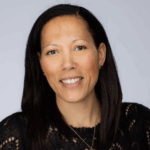
MaryAnn Ferreux
MaryAnn is the Chief Medical Officer for Health Innovation Kent Surrey Sussex and a Non-Executive Director for Kent and Medway NHS Partnership Trust. She has 20 years clinical experience working across both the Australian and UK health system, with specialist qualifications in health system leadership, management, and population health. She has held Board level roles as a medical leader in both primary and secondary care and is passionate about using digital and innovation to improve the patient experience for underserved communities, deliver better integration, and ensure equitable access to care. She is a thought leader for health equity in innovation and is leading on several projects to explore gender and racial bias in AI, debias policymaking and increase women in leadership for digital and technology. She has a special interest in researching health equity and the impact of the social determinants of health. She is leading several initiatives to promote equity, diversity and inclusion in medicine and is a Trustee and Chair of the Royal College of Physicians (Edinburgh) EDI Committee.
Professor Domhnall MacAuley
Domhnall MacAuley currently serves on the International Editorial Board for BMJ Leader.
Declaration of interests
We have read and understood the BMJ Group policy on declaration of interests and declare the following interests: none