There’s something uniquely humbling about sitting in a circle with the frontline health workers (FLWs) to check, “Can we build something together, for you?”
The idea of creating the resilience toolkit grew out from DISHA project where 140 FLWs across six districts highlighted their challenges, coping strategies, motivation, and support needs. In July 2024, The Resilience Collaborative (TRC), a global community of practice conducted, a consultative workshop, to update and implement a resilience toolkit for FLWs. The workshop convened 25 diverse participants; including academicians, program managers, researchers, and frontline health workers (nurses, psychologists, and dentists) to reflect on post-pandemic changes and integrate new evidence on resilience interventions. The recommendations from the workshop emphasized that a meaningful resilience tool for FLWs must be centred around their lived experiences and go beyond regular participatory approaches.
Based on these recommendations, TRC initiated a series of seven workshops (three with from India and five from other countries) using co-creation approaches, where the FLWs updated the resilience toolkit’s contents, sessions, process. The toolkit was also simultaneously deployed to gather insights on challenges, coping mechanisms, and interventions.
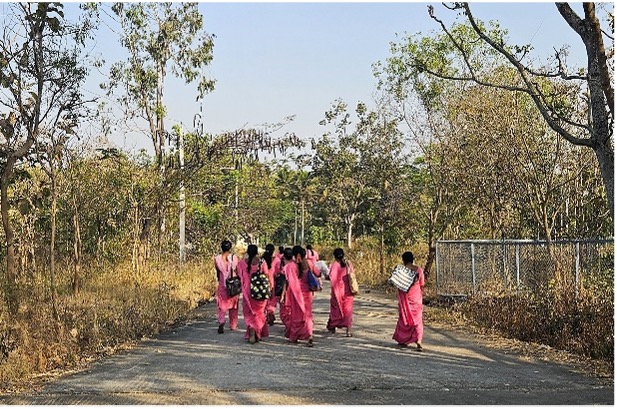
Ramnagara (Karnataka) and Siddipet (Telangana) were the first Indian sites in a global series focused on low-resource settings. Primary-care facilities were chosen as workshop platforms for their accessibility, inclusivity, trust among FLWs, contextual relevance, and cost-effectiveness, enabling meaningful engagement, and ensuring the tool reflected their lived experiences.
The workshops used participatory sessions, drawing exercises, group discussions, and reflections to create space for FLWs to express “what challenges or stressors they face”, “what coping mechanism they follow”, and “what support systems they have that truly motivate them to keep going”.
The first two subsections of this blog focus on deconstructing the idea of resilience and exploring purposeful ways to initiate meaningful conversations with FLWs followed by reflections on organizing co-creation spaces and managing group dynamics to build trust and openness.
Realigning our understanding with FLWs constructs of resilience: One of the challenges we encountered before engaging with the FLWs in Siddipet (Telangana, India ) and Ramanagara (Karnataka,India) was finding a locally resonant term for “resilience”, as Telugu in Telangana and Kannada in Karnataka are the primary languages. We tried using words like “మానసిక దృఢత్వం” (mānasika dr̥ḍhatvaṁ), “స్థితిస్థాపకత” (sthitisthāpakata) in Telugu and “ಗಟ್ಟಿತನ” (gaṭṭitana) in Kannada but they conceptualised it their own ways that largely echoed ‘a stronger person who can face adversities’. Amidst this difficulty, we felt resilience is not a common word they use, it is a life they live and can be expressed through their stories, body language, and emotions. This highlighted that while “resilience” is central to our toolkit, it must be grounded in lived experiences and culturally rooted expressions. Doing so, it will help resonate with FLWs and build meaningful engagement from the very beginning.
Beyond structured methods of expression: While the workshop included drawing, writing, and reflective group exercises, we found that many FLWs were not naturally comfortable with these forms of expression. Translating their thoughts into drawings or written words often disrupted their flow and created hesitation. What worked better was a natural flow of conversation and discussion yielding richer insights. This showed the importance of creating spaces for participants to express themselves in ways that feel natural and comfortable to them in a co-creation process.
Managing disruptions: The presence of higher authorities or overlapping work commitments can cause disruptions, divert attention, and make it difficult to build open dialogue and trust. Also, overly rigid agendas can become counterproductive in such dynamic environments. Flexible schedules, buffer time, neutral-venues, possibly outside routine duty hours are vital when co-creating with FLWs in unpredictable, high-demand settings.
Group size- In Ramanagara (Karnataka,India), we facilitated a workshop with 23 FLWs. While this size allowed broad input, evidence suggests that smaller groups (10–12 participants) yield richer and more interactive engagement. We call for designing global workshops with 10–12 participants per session to balance diverse perspectives and participatory richness.
Gender representation – During the co-creation process, we observed a higher representation of women. While frontline health workers are predominantly female, certain roles, such as the multipurpose health worker (male) in India are designated for men. Ensuring equal participation of women and men is vital, as gender dynamics can influence mixed-group discussions. Separate sessions give women the space to speak freely and later share insights jointly in mixed-discussion for balanced participation, though gender composition and its influence on group dynamics may vary across different contexts.
The self behind the service: Our engagement with the FLWs revealed that their lives revolve around others, their families, communities, the health system so much that they have forgotten to check in on themselves. To address their mental health needs, shaped by experiences beyond their formal roles or daily environments, we must recognize them as individuals, not just as healthcare workers, mothers or wives. Co-creation provided insight into this reality and a responsibility to reflect it in every tool, training, and policy we develop.
As we move ahead in validating the resilience toolkit across diverse global contexts, we will carry these learnings and ensure our approach is contextually relevant.
Authors: Sushree Nibedita Panda is a public health researcher working as Research Assistant at The George Institute for Global Health, India. Her research interests include health equity, health workers’ well-being, and health system research.
Shilpa Sadanand is a psychologist and a Program Manager at The George Institute for Global Health. Being a part of The Resilience Collaborative (TRC) team, her works focus on promoting the wellbeing and resilience of healthcare workers (HCWs).
Nikita Paul is a Communications Consultant with TRC team at The George Institute of Global Health, India. Her works centre around building engagement pathways, facilitating coalitions and dissemination of TRC’s evidence-based efforts.
Prachi Pundir is an evidence synthesist and working as a Research Fellow with The Resilience Collaborative project hosted by the George Institute for Global Health, India.
Ashish Manwar serves as program manager for innovation at the George Institute for Global Health. His work focuses on the intersections of living systems and anticipation, and the way they pertain to resilience and innovation across emergent systems for health.
Varadharajan Srinivasan leads TRC team, at The George Institute for Global Health, drawing on 25 years of experience in hospital management, health and development projects, and digital health. His works centre on designing and deploying evidence-based solutions to support and strengthen health systems.
Competing interest: None.
Acknowledgement: We gratefully acknowledge the contributions of all participating frontline health workers whose lived experiences informed and enriched the development of this reflective piece.
Handling Editor: Neha Faruqui