The Editors in chief of GUT, Professors Matias A. Avila, William Grady and Thomas Rösch, have selected Professor Antoni Castells from the Hospital Clinic de Barcelona and University of Barcelona, Spain, Professor Andrea Buron from the Hospital del Mar Research Institute, Barcelona, Spain and the Research Network on Chronicity, Primary Care and Prevention and Health Promotion (RICAPPS), Madrid, Spain, and Professor Uri Ladabaum from Stanford University School of Medicine, California, USA, to do the next #GUTBlog.
The #GUTBlog focusses on the paper entitled “Effect of long-term adherence on faecal immunochemical test positivity rate, positive predictive value and detection rate in organised population-based colorectal cancer screening” which was published in paper copy in GUT in May 2026. Professor Uri Ladabaum is the first author on this paper. Professor Castells is the senior author. Professor Castells and Professor Buron are co-leads at Barcelona’s Colorectal Cancer Screening Program.

Professor Antoni Castells, Professor Andrea Buron and Professor Uri Ladabaum write:
“On the 15th Anniversary of the Nationwide Rollout of Catalonia’s Colorectal Cancer Screening Program: Reflections on Population-Wide Faecal Immunochemical Test (FIT)-Based Screening
On March 18, 2026, we celebrated the 15th anniversary of the extension of organised faecal immunochemical test (FIT)-based screening for colorectal cancer (CRC) throughout Catalonia. The event featured the image of a “castell” (Figure 1) – a traditional Catalan human tower recognized as an Intangible Cultural Heritage by UNESCO – as a metaphor for the high level of coordination required among the multiple stakeholders involved in delivering an effective screening program. This celebration, and our recent publication in Gut reporting the effect of long-term adherence on screening results, are twin milestones for Catalonia’s program.
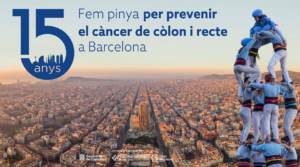
In 2000, a pioneering pilot CRC screening program was launched across 12 healthcare centers in L’Hospitalet de Llobregat, an industrial city of approximately 239,000 inhabitants within the Barcelona metropolitan area. Using guaiac-based faecal occult blood testing and drawing on seminal evidence generated in the U.S. and England, the initiative set out to answer a critical question: Could a population-based CRC screening program be effectively implemented in Catalonia?
What followed was a long but determined journey. It took nearly a decade for the Catalan Ministry of Health to endorse the program’s expansion across the region, and a further ten years to achieve full implementation by 2019. Far from being a delay, this timeline reflects the complexity of building a robust, equitable, and sustainable public health intervention at scale. This achievement was made possible by the alignment with European guidelines and, crucially, by an extraordinary collective effort.
Scientific societies spanning public health, gastroenterology, medical and radiation oncology, occupational health, and pathology worked in close coordination, alongside an engaged civil society represented by patient associations and charitable organizations. Together, they provided the strategic and evidence-based impetus for the public healthcare administration to transform a local pilot into a nationwide program, establishing a model of collaboration and perseverance that continues to save lives – “Fem pinya!” (this Catalan idiom loosely means “let’s come together;” it is the rallying cry for joining the base of the castell to ensure its stability and safety (Figure 1)).
Catalonia’s CRC Screening Program is publicly funded and promotes equitable access. Eligible men and women aged 50 to 69 are identified through the comprehensive Central Registry of Insured Individuals. Integrated demographic, clinical, endoscopic, and pathological data are captured within a centralized digital platform managed by the Catalan CRC Screening Office – enhancing traceability and coordination, and providing a powerful foundation for monitoring outcomes and guiding evidence-based decision-making.
The program is supported by a well-defined organizational structure, with dedicated administrative resources for service delivery, quality assurance, and continuous evaluation. These elements streamline the invitation process, enable rigorous assessment of performance and impact, and foster an ongoing cycle of quality improvement – positioning the program as a model of effective, data-driven public health implementation. Future priorities include developing a formal communication structure and harnessing resources for dedicated campaigns and local outreach, in order to improve engagement.
The program is based on mailed biennial FIT invitations, directing eligible individuals to collect the test kit from community pharmacies or primary care centres. Individuals with a positive FIT result are systematically referred to a local digestive disease unit, where a nurse specialized in CRC screening provides tailored counseling on the implications of the positive result, and the benefits and risks of colonoscopy. A diagnostic colonoscopy is promptly scheduled unless there are contraindications.
At the 15th anniversary of the program’s nationwide rollout, we acknowledged the urgent challenge of improving participation and longitudinal adherence. We discussed social marketing strategies, innovations in the invitation process, the use of messaging applications for call-recall systems, and electronic alerts for pharmacists and general practitioners to identify invitees who have not yet participated – there is an opportunity to strengthen our currently limited communication and outreach framework.
The convergence of the 15th anniversary of Catalonia’s program’s full implementation and our milestone publication in Gut illustrate a virtuous cycle of clinical science and dissemination for the benefit of the population feeding and reinforcing each other. Fem pinya!”