To watch this interview, please follow this link
Emilie Couchman: Today, I am talking with Liz Darlison MBE DL. Thank you so much for joining us. Can we start with your early life? Do you have any childhood memories that perhaps give insight into what your future career would involve?
Liz Darlison: I was quite ill when I was 11 or 12 years old and I had a two week stay in hospital. I think that’s probably where the seed was sown, of wanting to become a nurse. I didn’t really think about it again. I live in Leicester, which is the heart of the knitwear industry, and I went to state comprehensive school where you either went into the hosiery industry if you didn’t do well at school or, if you did reasonably well, you went into administrative office work. Only a handful of people stayed on and did A-levels and none of my friends did. I stayed on for a year, but I got bit lonely and left, and ended up working in the office of a knitwear factory. That would be very typical for my peer group in that era. Somebody said to me one day, ‘what do you see yourself doing?’ and I said, ‘well, I’ve always wanted to be a nurse.’ In those days people didn’t really guide you but I was very fortunate in getting some advice from a GP. My dad had a shop and I used to help my dad out at the weekends. The GP was a customer who one day said, ‘what are you going to do with yourself?’ And I said, ‘I want to be a nurse.’ He came back in the following Saturday and said, ‘I’ve arranged for you to go to the School of Nursing to look round’. That was it. He was a really kind doctor, who used to pick my dad’s brains to help him with his home renovations, and have a coffee. I now live in that village where that GP worked and he was an icon. But he is no longer with us.
EC: Maybe it was within you anyway, but perhaps that, ‘leave the ladder down’ kindness inspired you that you so obviously pay forward yourself. Is that because you’re a certain type of person? Do you think certain types of people go into such professions?
LD: Of those of us that go into healthcare, I think there is a core that go in because it feels like a calling in some way. But there are people who make really good doctors, nurses, physios and all the rest who happen upon it in some way. They don’t have that yearning for years, like I did, that I always wanted to work as a nurse. My dad died young of heart disease. My calling was coronary care. I worked in coronary care when I trained and when I was newly qualified. To progress you had to have had some ward experience, so I only went to the respiratory ward to get six months experience so I could go back to coronary care and be promoted. But that was it, I never left. I saw young people… and one young guy with, what we used to call idiopathic pulmonary fibrosis back in the day, he was in his 30s, absolutely gasping. In coronary care it was so much more organised and structured, where you could look at the monitors and see some of R on T ectopics and think, ‘oh, we better get ready because this guy…’ It was so structured and organised and yet, at times, on this respiratory ward, it was anything but. That was before we had midazolam on the trolley, it was awful. I never left, and the rest is history. That’s how I fell into lung cancer. A lot of the early money that was invested into cancer services went into diagnostics and in respiratory medicine, and that’s how I ended up working there. An opportunity came along.
EC: And you grabbed it with both hands?
LD: Yes, I did. I was a ward manager by then. I’d got three young children. I was working shifts covering 24-hour responsibility and, met Mick Peake, who ended up being lead lung cancer clinician for NHS England. He got a job in Leicester to sort out our lung cancer services because our performance was so poor. After meeting him, I went home and said to my husband, ‘I met the most passionate consultant and he’s really going to turn around lung cancer services and they’re advertising for a nurse to work alongside him.’ It was a sideward move, but it was regular hours, Monday to Friday, and with little children, that was a bit of a blessing. I just hung onto his coattails and got wrapped up in all his passion for service, redesign and change. We had a great team, the whole diagnostic team were on board, and that’s how I got involved in lung cancer. I fell into it. Still good at reading an ECG, though!
EC: Lung cancer as a starting point is common to a lot of people that I have met, whose main passion now is mesothelioma. Many services provided to people with mesothelioma are modified from lung cancer services, rather than having been created from scratch. And, thanks to the charity Mesothelioma UK and other funders, that more tailored specialist mesothelioma services are being developed. How do you think that specific mesothelioma needs vary with lung cancer need and, do you think it means that people with mesothelioma must have tertiary specialist care or do you think they can be cared for by more generalist providers?
LD: When I first came into lung cancer, there was non-small cell or small cell and no recognition of mutations or targeted treatments. And, as science has moved on, we realised that there are cancers within cancers within cancers. And the more specialist we get in the treatments we have available and being able to identify what’s driving, not just a particular cancer, but a particular individual’s cancer, it becomes much harder for us as healthcare professionals to help patients navigate and get the best out of health care. It’s driven by patients need to get the very best out of healthcare. We cannot be experts in everything. We need people to get go down a rabbit hole, run with the evidence and to find these niche treatments. They may only help 3% of people but, if you’re in that 3%…
So, we need to stop trying to deliver cancer care in every NHS trust and, for rarer cancers, we need to develop and encourage regional and national teams. Look at peritoneal mesothelioma for example, we’ve got a national surgical team in Basingstoke with a nurse dedicated to those patients and an amazing community of people living with peritoneal disease who know they are getting the best support, even if they’re not eligible for the treatment because they don’t meet the criteria or if their disease is not suitable for the cytoreductive surgery. But, knowing you’ve been reviewed by the national team, and that you’ve still got ongoing support as part of that national community, it means you matter. It means so much to people- that you matter. That’s what we need for every mesothelioma patient. Not every patient needs to be managed by a specialist centre; not every patient needs to be managed by a secondary care team, and some patients can be managed completely by their GP, providing there’s easy access back into either secondary care or a specialist team. The patient doesn’t necessarily need to be seen in secondary care. They can review patients remotely and then liaise with GPs or their local team. We’ve established this in Scotland. Scotland has a national MDT [multidisciplinary team], they’ve got a clinical trial portfolio, and they’ve got national audit. They have 200 patients a year or thereabouts, so it’s easier to manage that. But, if we could mirror what they’ve got in Scotland and do it in each Cancer Alliance although we don’t necessarily have to follow the geography of these Cancer Alliances as there are some organic regions within cancer care. If we achieve that in mesothelioma care, and we’re on the way to doing that, it could be a model for many other cancers to follow.
EC: When you are involved so closely professionally and personally with a rare condition like mesothelioma, you’re on the back foot in a lot of different contexts, such as, for example applying for funding for research. How do you cope with that? How do you keep going?
LD: My coping mechanisms have deteriorated more and more with time. If I’m honest. I get really emotional sometimes. I was in my 30s when I started Mesothelioma UK and I was full of optimism thinking: “…this is so obvious, this is such a preventable disease. It’s such an obvious area for health care to focus on and sort out because this shouldn’t be happening at all.’ But now, 20 plus years on, when nearly 50,000 people have died in the UK of mesothelioma during that time, and I’m now looking after people that were exposed after we started Mesothelioma UK, I do struggle. I was in London recently and found myself staring at Westminster thinking, ‘come on, wake up!’ Sir Keir Starmer, in his opening speech at the party conference, said ‘there’ll never be another Hillsborough or Grenfell on our watch’. And I’m thinking, ‘…27 times Hillsborough is happening every year on your watch because 2700 people are being diagnosed with mesothelioma.’ So, I do struggle as I ask myself why there isn’t there a national research program and a national taskforce looking at all of the issues around mesothelioma and asbestosis generally. At Mesothelioma UK, we’re dedicated to the NHS and trying to make the NHS the best it can be for people with mesothelioma but, why is it left to a charity to fund nurses that specialise in this avoidable, despicable cancer? Why haven’t we got a national clinical audit? Because, if we’re not measuring it, we can’t improve it. Why have we not got funding for specialist networks and MDTs? Why isn’t there money for this? Mesothelioma UK is also responsible for giving a voice to patients, because the nature of the disease means they lose their voice. They’re not around for long enough. So, we’re raising awareness and challenging the current management of asbestos regulations. We all have a responsibility to help the other organisations that are doing that because we should be preventing this.
While I’ve done quite a lot of postgraduate specialist respiratory courses, I’ve done a master’s degree in palliative care, and I’m a pretty good, all-round respiratory nurse who’s worked at quite a senior clinical level but, I’ve never had any training in asbestos and the diseases it causes, despite the fact that our country has the highest incidence of mesothelioma. That’s a basic thing. Every medical and nursing school in the country should be doing smoking cessation, and they should be doing cancer prevention, and they should be doing asbestos diseases.
EC: The word ‘shame’ just came into my mind there. Do you think that there is societal shame, because this just should not be happening…It’s almost that doctors or nurses or whoever say, ‘oh, well, that’s really rare. I don’t know about that.’
LD: You wouldn’t be allowed to say that about breast cancer or bowel cancer or lung cancer. I always try to turn it around to the patient’s perspective. As a healthcare professional its absolutely fine to say, ‘I really don’t know a lot about this disease, however, I know there are national centres of expertise, and I’m going to refer you to one of those, and I’m going to see you next week to make sure you’ve heard from them.’ To connect all those dots. The vast majority of patients who do find expert centres have self-navigated quite a bit, and that makes me sad. I am a glass half-full person, and we have some amazing clinical teams and we even have GPs doing research in mesothelioma. Where else does that happen? We’ve got some amazing clinical trials, amazing clinical teams, and our asbestos management industry in this country is absolutely amazing. Other countries who wish to address their asbestos presence have no expertise and no industry to deal with it, but we have all that. We have so many of the requirements to address this in a really comprehensive way, but nobody is leading that, and the only people that can lead it are the people in power.
EC: You set up the charity [Mesothelioma UK] and since then it’s established itself as an integral part of the UK NHS in the way that the NHS cares for people with mesothelioma. Along with other funding partners, Mesothelioma UK funds the majority of clinical nurse specialist posts. Is that the mechanism through which it’s managed to integrate into the NHS?
LD: We belong to an organisation called Cancer 52; that 52 being the 52% of people diagnosed with a rare and less common cancer. So, it’s comprised of all of the charities involved in those rare and less common cancers. There are over 120 different member charities. I’ve spoken to people who run some of the top four cancer charities, and I know that it is a unique selling point that we are so embedded in the NHS and so immersed in the clinical care of people with mesothelioma, while other charities really struggle to get that traction with the NHS. I think it’s because not many of the cancer charities have a CEO who is a nurse working in the NHS. Our board is very NHS strong, and we have a very strong patient panel for our research centre, with patients sitting on our board. It’ll be interesting to see when I hand over the reins, how much having a nurse as a CEO who still practices a nurse, affects things? I’d like to think that we’ve put in the measures and are sufficiently established that it will be sustained, because it is really important. We genuinely want to help our healthcare professional colleagues up and down the country to do their best for the people in front of them. We just want to make it easier for them to do that, and I hope we’ve done enough to sustain it, because it definitely does make a difference.
EC: Liz, thank you so much for your time and for enlightening us with your personal perspectives and wealth of professional experience. I wish you all the best in your ongoing endeavours.
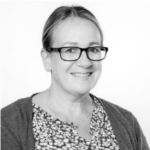
Liz Darlison, MBE, DL
Liz is a Consultant Nurse, a clinical expert in mesothelioma, an active researcher, and an advocate for people living with or supporting those with mesothelioma in the UK. She combines over 40 years of hands-on clinical practice with charity management, education, and clinical research to improve patient outcomes and raise public awareness of this rare, devastating disease. Liz was appointed MBE in the 2019 Queen’s Birthday Honours, and became Deputy Lieutenant for Leicestershire in 2024, in recognition of her professional contributions to the community.
Liz currently serves as a Consultant Nurse in the University Hospitals of Leicester NHS Trust, focusing on the treatment and care of mesothelioma patients. She also holds an Honorary Senior Lecturer position at De Montfort University, the University of Leicester. Liz is a founding member of the International Thoracic Oncology Nurses Forum, a lifetime honorary member of Lung Cancer Nursing UK, and the first nursing board member of the International Mesothelioma Interest Group.
In 2004, Liz founded Mesothelioma UK, a national charity dedicated to supporting people living with, or supporting those with, mesothelioma and advancing research in this field. Mesothelioma UK | Supporting people with this asbestos cancer Mesothelioma UK was initially established in 2004 as a Macmillan resource centre, and became a Charitable Incorporated Organisation in 2009 (1177039). Liz is the CEO responsible for the charity’s vision and strategic direction.
Declaration of interests
We have read and understood the BMJ Group policy on declaration of interests and declare the following interests: none