“When public health succeeds, societal changes make the individuals’ default choices healthy.”
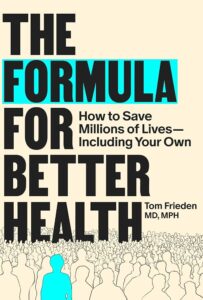 Tom Frieden begins his new book, The Formula for Better Health, with a sobering truth: public health suffers from the Cassandra curse. It is bestowed with an unparalleled ability to foresee future diseases and prevent millions of deaths yet cursed in a way that its warnings are seldom heeded. Frieden devises a simple three-step formula—See, Believe, Create—that we, the global health community, can apply rigorously to break the curse and translate evidence into durable population-level change.
To ‘See’ is to make visible what is otherwise ignored, whether microscopic toxins or macroscopic population trends. The importance of both ‘evidence-based practice’ and ‘practice-based evidence’ is unequivocal here. Frieden questions the external validity of randomized controlled trials, the supposed ‘gold standard’ for causal inference. I find this especially true when stretched to explain socioeconomic disparities, as in Poor Economics. Public health action requires deeper interpretive approaches accounting for social contexts and lived experiences. This tension echoes broader critiques of methodological universalism. I am reminded of the concept of ‘interpretive marginalization’, explained by Seye Abimbola in The Foreign Gaze; prejudicial imposition of foreign interpretive tools misrepresents local knowledge and leads to epistemic injustice.
The second part, ‘Believe’ confronts the fatalism of ‘disease inevitability’ and recognizes past successes. The power of optimism is emphasized as a political and operational necessity to Believe in the possibility of change. This is exemplified in a quip from the late renowned Indian tuberculosis expert, Dr Gulshan Rai Khatri, noting that the most important outcome of Frieden’s six years of hard work in India was simply ‘hope’; if a successful tuberculosis program can be implemented in Bihar (an Indian state with the poorest health indicators), it can be implemented anywhere. Optimism aside, twenty years later, tuberculosis unfortunately still kills about 34 Indians every hour, and Bihar remains one of the worst hit states. Belief must also extend beyond communities to those who wield power. A noteworthy example involves William Foege—renowned for championing the global smallpox eradication efforts—asking the health minister “Do you want smallpox eradicated on your watch or your successor’s?” A more dramatic example involves a Vermont legislator, whose vote would swing the statewide smokefree law. Before the vote, Matt Myers (Campaign for Tobacco-Free Kids) offered the legislator a stark choice: the next day’s full-page ad would either thank him for protecting Vermont’s children or hold him accountable for tobacco-related deaths.
The third and the hardest part ‘Create’ underscores that addressing major problems requires systematic organization, prioritization, effective leadership, identifying key interest holders, and incentivization. A whole chapter dedicated to “communication” demonstrates its vitality in creating momentum for reform. What stood out to me were the contrasting approaches adopted by two leaders, Jacinda Ardern and Donald Trump, to communicate to their citizens during the COVID-19 pandemic. It is bafflingly needless to reveal whose approach was optimal, but the other had violated all six of the U.S. Centre for Disease Control and Prevention’s basic principles of health communication within the first four months of the pandemic. The situation in 2025 is much more grievous, as rampant misinformation and unsubstantiated claims predictably gain traction when senior health leadership, including the secretary of the U.S. Department of Health and Human Services, departs from established scientific consensus.
A key element of the Create component is to identify the interest holders, i.e., the ‘concentrated losers’, including those who bear costs and the powerful industries that resist reform. Contrasting examples include the powerless upstate farmers who unsuccessfully protested the construction of a reservoir that has given New York clean water since the 1840s, or the powerful tobacco, soda, and fossil fuel companies that have successfully blocked taxation for years. In the age of AI and its significant environmental repercussions—massive energy and water use and resource depletion—I expect similar resistance from the powerful and wealthy AI companies. The past success of New York’s smokefree legislation shows that progress hinges not just on moral clarity but also on strategic negotiation and systems design. When the New York City Council demanded separate smoking rooms, the amendment was crafted brilliantly, imposing near-impossible design standards and a three-year operating period, effectively killing the option without blocking the law.
The success of public health lies in making people’s default choices healthy. Frieden draws on his earlier framework for public health action using a ‘health impact pyramid’. In short, actions that require larger individual effort (e.g., counselling and education) have the lowest impact on the population, while actions that demand collective effort—generally harder to change, such as socioeconomic disparities—have larger impact.
While The Formula can be applied to prevent future outbreaks, there is a strong emphasis on hypertension as the silent pandemic, which could potentially claim 14 million lives each year by 2050. The failure of the Million Hearts initiative in the USA can be attributed to political inertia and prevention paradox—large benefits to the community offer little immediate, tangible benefit to each individual. Nonetheless, the success of the World Health Organization HEARTS technical package in strengthening hypertension control in primary care, demonstrates the right application of The Formula. HEARTS Sees through simple, standardized BP measurement and effective systems for monitoring, Believes by reframing hypertension as controllable through multidisciplinary team-based care, and Creates by reorganizing delivery systems, aligning incentives, and enabling scale-up.
Frieden’s central provocation is that political, communicative, and organisational work determines whether evidence translates to a healthier default. The Formula nudges us to ‘See’ not merely by measuring what is measurable, but by asking the right questions, weighing burden against amenability and choosing the right individuals. Durable change requires trust, coalition-building, and deliberate systems design that passes the test of misinformation and stalled reform. The Formula is therefore a reminder that saving lives depends on seeing clearly, believing stubbornly, and creating relentlessly.
Book Reviewer
Gautam Satheesh

Gautam is a Doctoral Researcher at the University of Sydney, Australia, and a Research Associate at The George Institute for Global Health, India. A World Heart Federation Emerging Leader (2024) and an Emerging Voice for Global Health (EV4GH), his research focuses on strengthening primary care for non-communicable diseases in low- and middle-income countries, through improved access to essential medicines and implementation of team-based care. He integrates health systems research, pragmatic trials, and policy analysis, and co-chairs Health Systems Global’s Pharmaceutical Policies in Health Systems (PharmPol) thematic working group.
Declaration of interests
I have read and understood the BMJ Group policy on declaration of interests and no competing interests to declare.