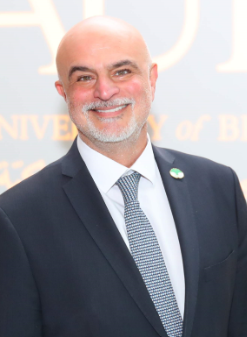
By Ali T. Taher, MD, PhD, FRCP
Ali is Professor of Medicine at the American University of Beirut (AUB), where he serves as Director of the Naef K. Basile Cancer Institute and Associate Vice President for Academic Centers, Development and External Affairs. He is internationally recognized for his pioneering work in thalassemia and iron metabolism, and led AUB’s Fellowship and Residents Research Program.
Professor Taher has played a central role in Lebanon’s thalassemia care through his long-standing involvement with the Chronic Care Center, where he has contributed to national prevention and treatment strategies. In 2011, he was granted the Fellowship of the Royal College of Physicians, and in 2012 earned a PhD from Leiden University for his ground-breaking research in thalassemia intermedia.
I have spent decades in medicine—rounding, teaching, publishing, advocating. I know the rhythms of the intensive care unit. I’ve heard the alarms, read the numbers, and spoken the language of ventilators, vitals, and vasopressors. I thought I knew this world.
But nothing prepared me for the silence.
Not the silence of the machines—those never stop—but the silence between people. The absence of words, of explanation, of presence. Not a clinical absence, but a human one.
For months now, my sister has been lying unconscious in the ICU. I have watched her—still, vulnerable, dependent on machines. Yet what has shaken me most is not her fragility. It is how easily we, as a profession, distance ourselves from it.
Rounds come and go. Notes are written. Plans are updated. But compassion rarely enters the room. Nurses pass. Residents glance. The attending may visit briefly, sometimes not at all. Days go by without meaningful communication. Questions linger. Messages go unanswered.
As a physician, I know how hard this work is. I know the pressure, the time constraints, the mental toll. But being on the other side—as a family member of someone who may never wake up—I also know what is missing: empathy.
Not sympathy. Not pity. But recognition. The small act of seeing the person in the bed not just as a case, but as someone’s whole world. The act of looking into the eyes of the family and saying: I see you. I’m here. I care.
Empathy does not require more time. It requires intention. A pause. A kind word. A willingness to stand in the discomfort with those who are suffering, not just around them (1).
What troubles me is that this is not unique to one ICU. I have seen this pattern across institutions. Young doctors, rushing from task to task, are overwhelmed and under-supported. Attendings, jaded by years of service, forget what it feels like to sit at the bedside as a son, a brother, a spouse. The culture of medicine has become efficient, but emotionally barren.
We teach our students how to read scans and write orders. But do we teach them how to listen? To sit in silence? To bear witness to pain without retreating behind a screen?
This is not a criticism of individuals. It is a plea for reflection. A call to return to the heart of our profession. Because without empathy, medicine becomes a transaction (2). And patients—our patients—deserve more than that.
So do their families.
My sister may never wake up. But I will never forget how it felt to be invisible in the room where she lay. And I will never stop believing that we can do better—for her, for others like her, and for ourselves.
Take-Home Messages:
- The gap between clinical efficiency and human presence should always be managed when dealing with palliative patient and the patient’s family
- There is an enduring need for showing empathy in medicine and all its encounters
- Teaching medical students how to listen to patients and their families should be a core of the medical curriculum
References
- Childers JW, Bulls H, Arnold R. Beyond the NURSE Acronym: The Functions of Empathy in Serious Illness Conversations. Journal of Pain and Symptom Management. 2023;65(4):e375-e9.
- Mroz EL, McDarby M, Arnold RM, Bylund CL, Kutner JS, Pollak KI. Empathic Communication in Specialty Palliative Care Encounters: An Analysis of Opportunities and Responses. J Palliat Med. 2022;25(11):1622-8.
Declaration of interests:
I have read and understood the BMJ Group policy on declaration of interests and declare the following interests: consultancy fees from Novo Nordisk, Bristol Myers Squibb (Celgene Corp), Agios Pharmaceuticals, Pharmacosmos, and Roche; research funding from Novo Nordisk, Bristol Myers Squibb (Celgene Corp), Agios Pharmaceuticals, Pharmacosmos, and Roche.
Funding:
The author received no specific funding for this work.