You don't need to be signed in to read BMJ Group Blogs, but you can register here to receive updates about other BMJ Group products and services via our Group site.

Irish Euthanasia Lecture Cancelled

20 Apr, 09 | by Iain Brassington

A curious story from the Irish Times: a lecture by Len Doyal on euthanasia had to be cancelled after disruption from protesters: he’s now complained to the President.  The protesters apparently shouted obscenities and, er, the Rosary.

There are more details here.  In the meantime, I just can’t help myself:
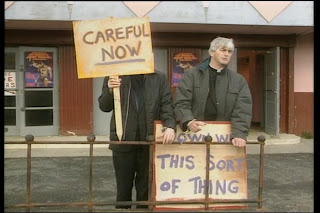
 Thanks to Richard Ashcroft and Sorcha Uí Chonnachtaigh for the pointer.


UPDATE: The HSE - that’s the Irish version of the NHS - has issued a statement on the incident, available here.

17 Responses to “Irish Euthanasia Lecture Cancelled”

  1. http://hiddenireland.wordpress.com/2009/04/11/ur-lady-sends-euthenasia-speaker-running-from-cork-university-hospital/#comment-364

    Why does it not surprise me to see a British blogger mock the Irish culture and religion?

    And before you freak out and say that Sorcha is Irish, there have always been traitors.

    Perhaps you could do us the courtesy of keeping your British medical wizards out of our country? In return we wont have to keep pointing out what a stinking cess pit of immorality and bloodlust the UK has become.

    But dont just take my word for it, see;

    Why England is rotting

    England leads Europe in illiteracy, obesity, divorce, drug use, crime and STDs. Bloody hell

    http://www.macleans.ca/article.jsp?content=20070611_106150_106150

  2. Cheers for that. You’re right to point out that the UK has more than its fair share of social and welfare problems. I was going to be scathing about that later today if I get the chance. Watch this space…

  3. Dear O’Donnell,

    You were right in assuming my nationality is Irish (I imagine the name was a big clue) but you are quite mistaken in your spurious accusation of treason.

    It is unclear whether you are basing this accusation on the fact that I drew Mr. Brassington’s attention to the incident or on the assumption that I am in favour of euthanasia, so I will address both possibilities. Firstly, drawing attention to an incident (the facts of which are uncontested) does not constitute an act of treason. Secondly, you have no grounds for assuming that by drawing attention to the incident I am in favour of euthanasia (or that I dislike Irish culture or the predominant religion in Ireland).

    I am a citizen of Ireland, which is a democratic republic and it is my democratic right - if not my duty - to speak of events occurring in my country and to highlight anything I find unacceptable. I support free speech and free association - this includes the right to speak about euthanasia and the right to protest against it - so long as both are done in a peaceful manner. However, the protest at the CUH lecture was deemed to create such a volatile situation that the safety of the speaker and audience was compromised. This is something I cannot support.

    Furthermore, it is incomprehensible to me that a group that disagrees with the practice of euthanasia would be afraid to engage in a civilised debate; listening to opposing arguments and making their own. This protest was not against euthanasia but against a lecture and discussion on the issue. I don’t agree with preventing debate.

    I would like to point out that I am also willing to put my name to statements I make, as I am doing here. It may be easier to slander people when you use a ‘nom de plume’ to hide your identity, but it is pretty cowardly.

    Finally, if you would like to engage in debate rather than insulting people I would be more than happy to participate.

    Yours sincerely,
    Sorcha

  4. O’Donnell -

    oooh, TRAITORS, is it? Wow. Wowowowowow.

    Get your own house in order first perhaps before railing on the UK? Ireland isn’t exactly paradise.

  5. Brassington, you are outrageous, mocking what you don’t seem to understand. Do you expect people outside of Britain to define it by the characters of Little Britain. So why Ireland by Father Ted.
    The substantive issue of the protest was the right to life.
    The most fundemental right and expectation in a civilised society. Those people protested so as to deny the monster a platform to spew his toxic inhumanity. To suggest that so called mercy killing is a right is intensy wicked.In Ireland anyone with terminal illness will recieve all the pain relief opiates necessary to control pain, they may die as a result,but the intent is never to kill and always to ease suffering.This is the vital moral distinction.
    Look to your own grossly degraded society ,where mothers pregnancies are screened for Downs syndrome and the like, and then they are put under tremendous pressure to kill their unborn child.And thats what it is killing the most vunerable members of humanity,terminations is a word that should be left for where trains stop.
    Do you conside it a right,a social good, that women are encouraged to kill their babies? if so the Battle of Britain was fought in vain. Do you not see that giving a so called right to a few depressed, often malantrophic elderly is the thin edge of a wedge that can only lead to a a lessening of the value of life and to a society that has fallen to sub-human levels of barbarity.Did the “well intentioned” British legislators of 1969 foresee that Britain would have the highest abortion rates in western Europe,in number multiples of what they expected.
    I am not a religious man,in fact I’m as agnostic as a lamppost,however I’ll leave you with this little widom and hope it penetrates, What you sow so shall you reap.

  6. Fintan -
    Thanks for that: I’ll take your points in order. I have no problem with the substance of the protest: you can object to what you want all you want. My mockery - if that’s what it was - was directed at the manner of the protest, which was (if the newspaper is to be believed) absurd and childish.

    I do not easily accept that there is a right to life, because I have trouble with the idea of rights generally. However, even if there is a right to life, the question would remain open concerning who possesses it, and whether it’s alienable. If I do have a right to life, then that’s still a long way from saying that I have a duty to live it. I don’t have any such duty. Moreover, if a medical professional is certain that I am unlikely ever to have a life that is not a burden, then I think that there might be room for him to end it on my behalf. Clearly, there would have to be more said on this - but I don’t have such a big problem as all that with the principle.

    I don’t think it’s true that mothers are pressurised to terminate disabled children. But, again - even if there is a right to life, I don’t think that it can easily be extended to a foetus. Noone in their right mind thinks that abortions are good; plenty of people, though (and I’m one of them) think them permissible in certain circumstances.

    The “thin end of the wedge” argument is specious: it’d only convince people who lack any but the most rudimentary facility of moral discrimination. The appeal to the Battle of Britain is silly. And the high abortion levels in the UK - weren’t we talking about euthanasia a minute ago? - are bad. Maybe if we didn’t have such an awful attitude to sex education and disdain for our kids over here, there’d be fewer.

    Finally, I’m baffled by your sowing and reaping point. Maybe I’m just a bit thick.

  7. Iain,

    Yes the the protest seemed childish and absurd,however it was effective.It reminded me of a protest held by similar types against Peter Stringfellows’s lap dancing club in Dublin.Those concerned residents loudly protested,harangued and generally made life difficult for the clubs clientel,result the club had more dancers than customers,closed afer after a few months with losses reported to be around the £2million mark. Stringfellow hoping to make a handsome profit, scuttled back to England with his tail between his legs.The point of the story being crude tactics can be the most effective.

    An individual may not feel he has a duty to live,he may wish to commit suicide,and he has a freedom to do this,in that he would not and should not be committing a crime, but all those around him have a duty to stop him.If someone were to tell me they were leaving to throw themselves off a bridge I would have a duty to inform the police,I would be morally obliged to prevent it happening, society has the same duty.
    Hard cases make bad laws,of course there are people whose lives are completely negative,a burden to themselves ,and some would argue, to society.I would argue that the role of society is to help carry that burden in the way that communities have always done,to give all possible support.

    I don’t see how it is specious to believe that hard cases are the thin end of the wedge.There are increasing reports in the Netherlands of elderly people requesting euthanasia, because they percieve themselves as a burden to their famalies, and that some famalies are encouraging this. Furthermore the example of abortion in Britain should be a clear warning that these things can evolve into a much bigger problem, than what was originally envisaged. Of course abortion and euthanasia are but two sides of the one coin.
    Britain fought valiantly against a power ,whose primary philosophy was that some some human beings were not worthy of life , and a rational solution would unburden the state .It’s no accident that there is stictly limited abortion in Germany, and little talk of euthanasia.

    Finally ,Iain, you may be old, living in a society with different values than today’s, with a demographic top heavy
    with the elderly, are you sure it will be safe?

  8. Fintan -
    I’m perfectly sure it’ll be safe. A world in which I can be helped to die should I want to strikes me as being a humane and desirable world. There’s still all the difference you can imagine between that and being forced to die against my will. Moreover, a world in which I can be helped to die and to do it effectively is a world that’s better than one in which I’m forced to do it amateurishly with the risk of fucking it up and making things much worse.

    Do you have evidence from the Netherlands? The evidence from Oregon tells a completely different story: many people have had the drugs for suicide prescribed, but few have used them - the hypothesis being that the reassurance that you can check out if you want makes life more bearable, thereby reducing the chance that that’s what you’ll do.

    Of course we should support those who find their lives burdensome - you can have both.

    Finally, I just don’t see abortion as all that big a moral problem. The conditions that make it necessary and desirable, perhaps - but abortion per se, not so much. A foetus doesn’t strike me as all that interesting. Oh - and, finally and a bit - while there might be similarities between abortion and euthanasia, they’re not all that closely related: the presence of the mother, for example, strikes me as a crucial difference. There’re similarities between sharks and dolphins, but we’d be foolish to let what we say about one inform what we think about the other.

  9. OK - the first sentence of that last paragraph is badly put. Bah. It’s late - I’m sure you get the picture…

    :)

  10. Iain,

    I would’nt be so sure that the future is predictable and safe.Already,even before voluntary euthanasia laws, there are calls from high places for elderly patients with dementia to end their lives because they are a burden on the nhs and their families. This call comes from influential bio-ethicist Mary Warnock,aka “lady”, Baroness Warnock.She has said, she hoped people will soon be “licensed to put others down”.She has wrote that some people “have a duty to die”.Remarkably this whack job is regarded as Britain’s leading moral philosopher.She is also the patron of a charity that seeks to correct inner-city social disadvantage by teaching those kids latin and greek. Sounds to me like she is a candidate for her own medicine.Britain really does give the finest people titles,Baroness Warnock, Sir Fred Goodwin,ect,ect,ect.

    As to the future of Dutch euthanasia,even its proponents harbour fears.Self described killer, dr Pieter
    Admiraal, states, “We realise there will be dementia patients by the tens of thousands.So I’m a little bit afraid.I really think that we may accept that,for purely economic reasons,that they can stop life after a period of three years of dementia,for instance.I can imagine that.I don’t think you can stop it.I don’t think we can prevent it”.
    It seems to me that whenever a limited voluntary euthanasia law is passed, there is substantial risk that involuntary euthanasia will follow.Certainly it shifts societal attitudes and acceptance,the bar is lowered by increments. People will be pressed into euthanasia.Australian ,dr Rodney Styme,vice president of “dying with dignity”
    suggests “the sick and dying are a burden on their carers,and by committing suicide they can alleviate that burden and end their own suffering”.

    Published Dutch statistics grossly under report euthanasia deaths.This subterfuge is achieved by not counting cases where doctors administer morphine or sedative overdoses,with the intent to kill,as euthanasia,since morphine is considered a pallitive drug.Reliable figures from 1990 point to more than 10,000 deaths through this method.According to a paper in the Lancet,1991 Sept 14,from a sample of 2250 deaths; 17.5% were by administration of morphine overdose,(many of which were of course double effect),a further 17.5% were by decisions not to treat.Euthanasia by lethal drugs was done in 1.8% of patients. Regarding consent,even before laws were passed, a 1991 study found 1041 involuntary deaths by euthanasia.However, statistics for proprietary euthanasia drugs are as follows; 2006-1923, 2007- 2120.That’s a 10.2% increase on the year. These figures do not include involuntary deaths.

    The conncern is not just the numbers,but the increasing spectrum of condtions considered fit for euthanasia. The Groningen guidelines are shockingly liberal.They include the pain of living,ie reactive depression,bi-polar
    disorder.So purely psychological suffering is included,and depressed patients have been voluntarily euthanased.That’s a dangerously open situation ,especially in
    a society suffering such anomie,as Holland clearly is.

    Do you honestly think a depressed person should be killed by the state? even if it is at their own request.There are so many approaches to treat the depressed,chemo-theraphy,cognative theraphy, electro-consulsive theraphy and proably the best of all, regular sessions in the pub.

    Yes certainly there are distinctions between abortion and euthanasia,but fundementally they are about the willful destruction of human entities,as such they belong to the same set.The overlap of peoples attitudes to either issue is striking.I don’t think the mother’s position is that vital since the childs right to life trumps the mothers right not to be discommoded,(at least pregnancy is natural)
    and she can have the child adopted,no shortage of takers there.

    As regards the differences between sharks and dolphins,I really couldn’t say, I’ve only eaten shark.

  11. Fintan -
    This is going to be a bit rushed… but here goes.
    1. Warnock’s ideas about a duty to die are more nuanced than you allow. Besides - isn’t it the job of the philosopher to bat ideas around to see which work?
    2. Teaching Latin and Greek strikes me as a very good idea indeed - Latin particularly. As well as providing an insight into the structure of W. European languages and grammar, it teaches clarity of thought, provides a cultural depth, and stimulates scholarliness for its own sake. Three cheers for all of them.
    3. What’s Fred Goodwin got to do with anything?
    4. One person’s worries about a slippery slope does not amount to proof that there is any such thing.
    5. If you’re going to dismiss published figures, whence do you get your evidence? Aren’t published figures the best we have to go on?
    6. I’m not sure that quoting figures from Holland in the early 1990s will tell us much about the consequences of legalising euthanasia, since euthanasia was only legalised there in (if I remember correctly) 2002.
    7. Involuntary deaths are straightforwardly murder. They don’t tell us the first thing about voluntary or non-vol. deaths.
    8. I see no problem about people with mental illnesses having access to assisted suicide. A mental illness doesn’t automatically mean you’re incapable of making a serious decision - what matters is whether your judgement is clouded. And since anyone can have clouded judgement, mental illness drops out of consideration wholesale.
    9. Yes, there are other ways to deal with any illness. So what? Incidentally, if you think that drinking is a sensible treatment for depression… um… it ain’t.
    10. I simply don’t think that the foetus has a right to life; and, even if it does, I don’t think that that means it’s always wrong to end the pregnancy.

  12. Iain,

    I’m sure Warnock’s ideas are more nuanced than some of her more controversial statements.Perhaps she was attempting to provoke debate,but I doubt it. More likely she was exasperated with the strong resistance to her ideas, and let slip her viscreal feelings.I expect you will accuse me of rash generalisations,but considering her milieu and her associations,it wouldn’t be unsound to suspect that she has a less than sympathetic attitude to the weak.She has called for involuntary deaths,or as good as,”duty to die”. Her emphasis has been,cost to the state. As you say such deaths are murder.
    Decency limits what philosophers should throw into the public arena.
    No doubt, some will benifit from learning latin. But with basic literacy skills often lacking,it may be a case of the cart before the horse.Time will tell.

    Most reasonable people should at least entertain the possibility of a slippery sloap.It’s hardly a minor concern . The slippery sloap is evident in Holland,which has had de facto euthanasia from 1973. The figures show constant growth. Again 2006- 1923, 2007-2120. Thats a ten percent increase. By the way, I did not dismiss published figures,after all even there, there is an upward trend,I qualify them for reasons previously stated.

    “If a medical professional is certain that i am unlikely ever to have a life that is not a burden, then I think there might be room for him to end it on my behalf”.
    How can a medical professional be sure of this in the case of mental illness.Most depression is reactive,and people usually recover without intervention. Organic depression is treatable(electo convulsive therapy is higly efficacious,yet unfashionable)How can a doctor act in such circumstances. In the case of mental illness it’s not possible to predict the future state of mind with certainty. It’s also unclear whether people are truly sane when depressed. We might say they are not themselves.Reason is not the totality of the mind.
    Actually I don’t think drinking is a solution to depression, but getting out and meeting people,with just enough drink to loosen inhibitions is in no way a bad thing.Reseaech into happiness has found that those who belong to the most social groups, tend to be the happiest.
    The more someone interacts with the community, the better.

    I agree it’s not always wrong to end the life of the foetus.The right to life of the mother supersedes the right of the foetus.

  13. Fintan -
    You’re still just speculating about Warnock - I’m reasonably sure you’ve not read the paper, or that, if you have, you’re taking the odd turn of phrase wildly out of context. As for your claim about decency limiting what people throw into the public arena - well, I’m not sure I agree; moreover, whose decency? (Look: imagine philosopher P who comes up with conclusion C. If he thinks he’s correct, then it’s hard to see how a decency appeal would make any difference - unless you think that uncomfortable truths and truth-claims should be cencored just by virtue of their being uncomfortable. Moreover, allowing that C is a moral claim, wouldn’t it be strange to suppose that the action considered in C might be permissible, but that talking about it wouldn’t be? That is - to imagine P saying to himself, “Well, I think it’s OK to do this action, but I’d better not say so.”? I find that incompehensible.)

    Yes, there are ways to treat man mental illnesses, and these will probably get better in future. So what? Isn’t that a red herring?

    If you could point me to the Dutch figures you have in mind, I’d appreciate it. Note, too, that even if your worries are realised, that doesn’t tell us anything about euthanasia in principle: it simply tells us that we have to be careful in framing a law. But that hardly seems like big news.

  14. Warnock’s argument is that wemust respect the automnous wishes of others and not place our judgement about the value of anothers life above their own. OK, I have problems with that but can appricate what she’s saying,but when she advocates killing people for the benifit of others,thats when she should be sent to coventry. - Dementia sufferes have a duty to die - in an interview with the Church of Scotland’s magazine,Life and Work,she claims that dementia suffers should end their lives because of the strain they put on society and their families.In an interview with the Sunday Times(Dec-12-2004)”If parents want to keep premature babies with unviable lives on life support machines,they should strump up the cost” So a two tier system as to who should live.There may be a high mortality rate for premature babies but it’s not 100%.At the onset of an intervention the outcome isn’t known.Otherwise doctors wouldn’t intervene.Yet remarkably one of her arguments for introducing euthanasia into Britain is to prevent two tier access to euthanasia. From The Times (Oct-4-2008)”euthanasia abroad would mean a two tier service”-So she is worried about the poor not being able to afford to have themselves killed,but not worried about the poor being able to keep their babies alive.In fact it’s preferable if they die. What a lady. Would it be a bit rash of me to suspect an underlying class bias, and with regard to premature babies, an eugenic undertone?
    You say that involuntary deaths are straightforward murder and since dementia patients can’t give consent, then clearly Warnock is calling for murder.
    How can wilfull murder be a fit subject for philosophical discourse.To accept that is to allow an attack on the basic human decencies that are at the foundation of our civilation,it is barbarous.

    I am not introducing a red herring,it’s pretty much irrelevant to my point, whether or not treatments for mental illness improve in the future.It’s not even that vital that they exist today.You seem unwilling to accept that by your own criteria your argument falls down,in regard to mental illness, since mental illness is usually transitory even if the period of depression is years. Besides even if a mentally ill person is sane,Idon’t think teeir in a position to make such a decision.If someone had lost thiefamily in a car crash,were in a state of grief,and requested euthanasia,would it be ok to allow that? clearly no,and the same is essentialy true with the mentally ill.

    The Dutch statistic that the proponents of euthanasia areinterested in is the reduction from 3,500 in 2001 to 2325 in 2005. What they are not interested in is the increase in terminal sedations and morphine overdose with the intent to kill.It would be naive to think there is much to learn about the consequences of introducing legalised euthanasia fro official Dutch statistics,the whole thing is a dogs dinner.
    Look, the slippery slope is real,but not straightforward.For one the statistics themselves are very slippery,due to the very very limited definition of euthanasia the Dutch use.Also there is credible evidence of under reporting. In 2005 the Dutch deputy health minister Jet Bussenmaker speaking on the release of data said “the most important finding of the research is that 80% of euthanasia cases are noe being reported”. Furthermore the 2002 legislation codified what was already accepted practice.Isn’t it a bit of a diversion to say that your not sure that figures from Holland in the early 1990’s will tell us much about the consequences of legalising euthanasia in 2002.

    “In 1990 the Dutch Patients Association, a disability rights organisation,developed wallet sized cards that state that if the signeris admitted to hospital “no treatment be given with the intention to terminate life.” Many in Holland see the card as an necessity to help prevent involuntary euthanasia being performed on those who do not want their lives ended,especially those whose lives are considered low in quality ”

    Deadly Compassion p151

    In 1993 the Dutch senior citizens group,The Protestant Christian Elderly Society surveyed 2066 elderly on general health care issues. The survey did not address the euthanasia issue in any way ,yet 10% of the respondent clearly indicated because of the Dutch euthanasia policy, they were afraid, that at a certaain moment, on the basis of age, treatment will no be considered no longer economically viable,and an early end to their lives will be made

    Camberra Times, 6-11-93

    We need to go back to the early 1970’s to appreciate the growth in deaths.Finally the Dutch are proably near the bottom of the slope, for now. The numbers will increase incremently as the ratio of sick and elderly becomes too burdensome, in the eyes of the state.Of course this will be due to the high abortion rate and low birth rate of previous decades.

    there are about 900 non voluntary euthanasias each year

    Researchers at the Erasmus University Medical Centre Rotterdam 18,000 people or 7.1 of all deaths in the Netherlands in 2005 involved deep sedation an increase from 6% in 2001.
    The total of of procedural deaths was 9.7% of all deaths in 2005, according to a 2007 New England Journal of Medicine report
    The 2006-2007 figures are frm the dutch newsagency ANP.

    According to two reports in the Lancet there are about 90 eugenicinfanticides per year.Dutch figures do not include these as they are done by dehydration, a practice not considered euthanasia as it is passive rather than active.A study published inin 1997 in the Lancet, determined that approximately 8% of all infantd who died in 1995,about 80 babies, were euthanised by doctorssome some without parental consent.
    Death bythirst and starvation a cruel and prolonged dispatch.If you were to do it to a dog ,you’d face gaoland utter contempt.These babies are killed because the are considered monsters.But their not the real monsters, are they?

    Ithink it’s very foolhardy to think that even a carefully drafted law, will not be subjected to revision or reinterpretation over time.The great danger is that onceyou establish a right to euthanasia for the competent volunteer,it could be argued that the incompetent have that right too.And having introduced into society a right to die,it can quickly mutate into a duty to die. Britain is particulary open to this possibility because she lacks a written constitution.
    The only safe bulwark against such horrors is not to legislate for euthanasia.

  15. Sorry IAIN, I somehow forgot to address you.

  16. Sorry,she said are now being reported

  17. Yeah. But no but yeah but no.

    ps - that murder is wrongful is of necessity true. Murder is a word that means wrongful killing. It is foolish, though, to say that that puts it beyond argument.

    1. What actually counts as murder is up for debate, and not universally agreed, or fixed over time even within the same place.

    2. Sometimes we have to do something that is wrongful to avoid a greater evil. Even the Pope accepts this.

    Yeah. But no but yeah but no.

Leave a Reply

You can follow any responses to this entry through the RSS 2.0 feed.
JME blog homepage

Journal of Medical Ethics

Analysis and discussion of developments in the medical ethics field. Visit site

Latest from JME

Latest from JME

Blogs linking here

Blogs linking here